
AI Blogging Service Explained: Beginner’s Guide
 Blogie
Why AI Blogging Services Are Suddenly Everywhere

If you feel like AI blog writing popped up overnight, you’re not imagining things. A couple years ago, most “AI writing tools” were basically fancy autocomplete. Now, an AI content writing service can take a rough idea, turn it into a structured post, and even help you publish it—sometimes without you ever leaving one dashboard. That’s why you see “AI blogging service explained” threads all over social media and founder communities: people are trying to figure out what’s real, what’s fluff, and what actually saves time.
What changed in the last 24 months
The biggest shift is that the underlying models got much better at planning, not just writing. Instead of producing generic paragraphs, they can follow an outline, hold a consistent tone, and cover subtopics in a way that feels intentional. I’ve also seen platforms bundle the whole workflow—keyword research, drafting, editing, publishing—so the tool feels more like a “blogging assistant” than a text box.
Another change is the market itself: content teams are under pressure to publish more often while budgets stay tight. That demand pulled AI out of experimental “nice-to-have” territory and into daily operations. For a practical perspective on how real people are using AI while blogging, Andrew Chen’s notes in How I use AI when blogging are worth skimming.
Who benefits most (and who doesn’t)
The sweet spot is small teams, solo founders, and marketers who know their product but can’t justify a full-time writer. If you’re trying to stay consistent—say, two posts a week—an AI blogging service explained properly can give you a repeatable system instead of “blank page anxiety.” In my experience, SaaS companies get especially strong leverage because they can turn product knowledge into tutorials, comparisons, and use cases quickly.
On the other hand, if your niche is heavily regulated (medical, legal, financial advice) and you don’t have an expert reviewer, AI can create risk. And if your brand voice depends on lived experience, original reporting, or strong opinions backed by data, AI alone won’t cut it—you’ll need heavier human editing for AI content.
A quick reality check on hype vs. outcomes
AI won’t magically rank your site or replace strategy. The outcome you actually want is “helpful content published consistently,” and that still requires choices: what topics matter, what audience you’re targeting, and what your point of view is. Think of AI as the engine, not the GPS—without direction, you’ll burn fuel and still end up nowhere.
That’s why I like platforms that treat the workflow seriously, not just the writing. If you’re building a real content system, a tool like Blogie (which combines research, drafting, editing, and publishing) is closer to what most people actually need when they search “AI blogging service explained.”
What an AI Blogging Service Actually Does (Plain English)

When people ask for an “AI blogging service explained,” they usually want to know one thing: what am I actually paying for? At a practical level, an AI service turns your inputs (topic, audience, goal, tone) into a post that’s structured, readable, and optimized enough to compete. The best ones don’t just generate text—they help you make decisions faster and publish with fewer moving parts.
From keyword to outline to draft
A strong workflow starts before the first sentence. Many tools can suggest keywords, cluster related topics, and recommend headings based on what’s already ranking. Then you get an outline that matches search intent—so the final draft isn’t just “about the topic,” it’s organized the way readers expect when they land from Google.
In practice, this can feel like having a content strategist in the room. You describe what you want (“beginner guide for X,” “comparison of A vs B,” “how-to for onboarding”), and the system proposes a structure with sections, FAQs, and sometimes even internal linking suggestions. That’s the core of SEO content automation done well.
Built-in SEO features you should expect
At minimum, you want title and meta description support, heading hierarchy checks, and basic keyword placement guidance. Better systems also help with readability (shorter paragraphs, scannable lists), semantic coverage (related terms), and formatting that looks good when published. Some platforms will even generate image suggestions, alt text, and schema-friendly sections.
If you’re evaluating options, it helps to understand how modern marketing teams think about AI-driven content production. This overview—AI Blog Writing: AI-Driven Marketing Content—frames AI blog writing as part of a broader system, not a one-off trick.
Where humans still plug in
Here’s the honest bit: humans are still responsible for truth, taste, and tone. AI can summarize common knowledge quickly, but it can’t reliably verify claims without being guided and checked. So you (or an editor) still need to validate facts, add product-specific insights, and remove the “generic internet” feel.
That’s why the best setup is AI for speed + human editing for AI content for credibility. With blogie.ai, the value is that you can draft and refine in one place, instead of exporting to docs, pasting into a CMS, and losing time to formatting.
The Most Common Service Types: Tool, Agency, or Hybrid
Once you’ve had “AI blogging service explained” in plain terms, the next question is: what kind of service am I choosing? Most options fall into three buckets—DIY tools, done-for-you agencies, and hybrid setups that mix software with light support. Each one can work, but the best fit depends on how much time and content judgment you can realistically bring to the table.
DIY software subscriptions
DIY tools are the fastest to start and usually the cheapest month-to-month. You pay for access, generate drafts, and handle editing and publishing yourself. This is great if you already know your niche and just want the writing speed-up for consistent AI blog writing.
The tradeoff is you become the editor-in-chief. If you don’t have a process for briefs, reviews, and internal linking, you can end up with a pile of “pretty good drafts” that never quite become truly publish-ready posts.
Done-for-you AI-assisted agencies
Agencies that use AI typically sell convenience: you give them topics (or they suggest them), and you get finished posts back. This can work if you’re short on time and want someone else to manage consistency and deadlines. It’s also helpful if you want strategy baked in, like topic clusters and refresh schedules.
The downside is cost and distance from your brand voice. If the agency doesn’t interview you or learn your product deeply, the writing can still feel generic—just more polished. If you want a broader take on what “AI blog writer” really means, this breakdown is useful: An AI blog writer explained: How.
Hybrid workflows for small teams
Hybrid is where I see a lot of SaaS teams landing: use a platform to generate and manage drafts, but keep final approval internal. You might have a marketer handle outlines and optimization, while a founder or PM adds real product insight. That’s often the cleanest balance of speed and authenticity.
Platforms that combine writing and publishing make hybrid especially smooth. For example, Blogie is built around the idea that you shouldn’t need five tools just to publish one post, which matters when you’re trying to keep a weekly cadence.
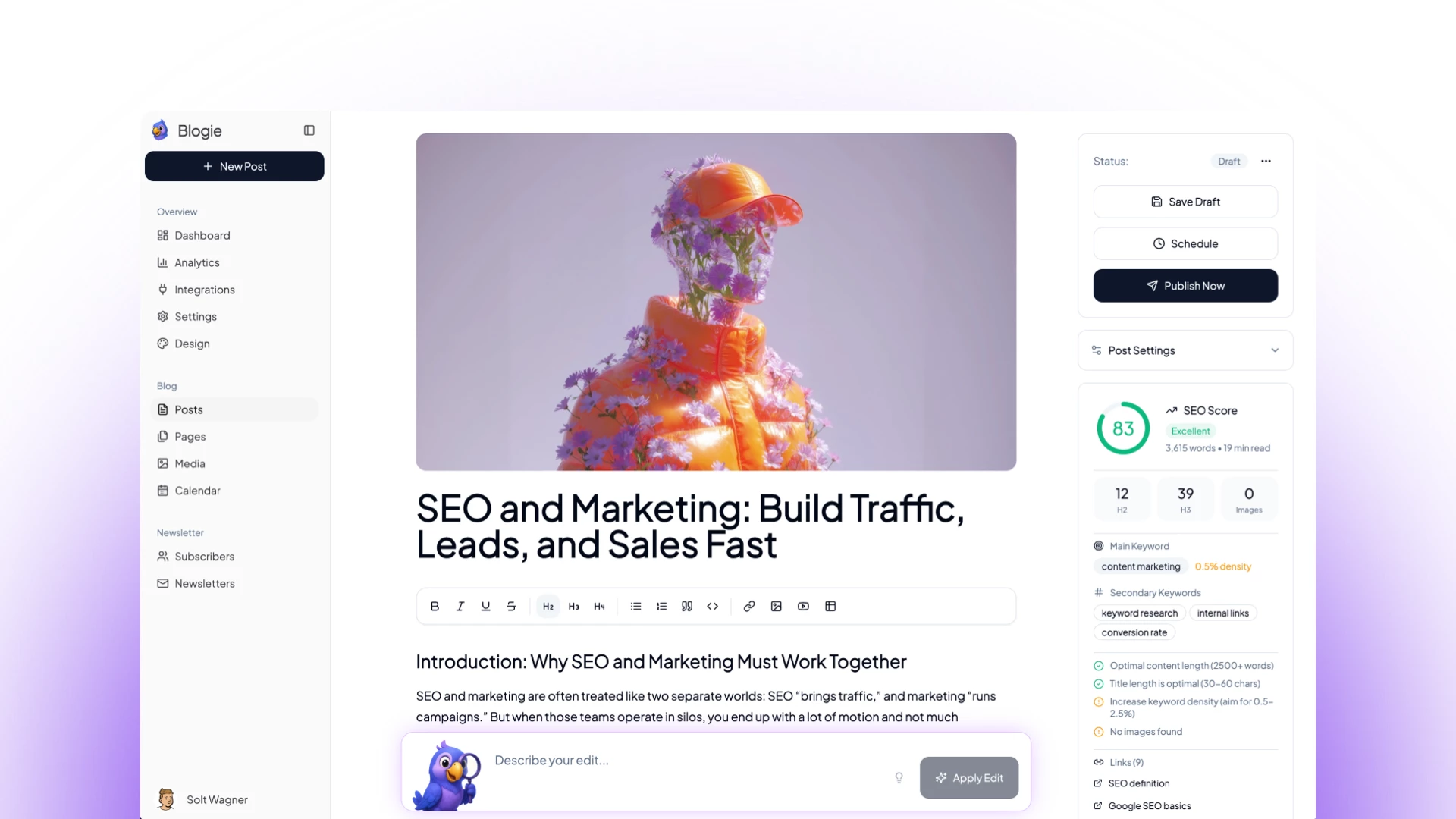
How the Workflow Works Step-by-Step (So You Can Picture It)
If you’ve been searching “AI blogging service explained,” you probably want a concrete mental model—not vague promises. Here’s the real workflow most teams end up using. It’s not complicated, but the order matters: a good brief produces a good draft, and a good edit turns “acceptable” into “publish-worthy.” The best systems also remove the annoying parts like formatting and uploading.
Briefing: inputs that make or break the output
Your results are only as good as your brief. A helpful brief includes: who the reader is, what problem they’re trying to solve, what the post should help them do, and what you want them to do next (subscribe, try a product, compare options). I’ve found that adding 3–5 “must-include points” prevents the AI from drifting into generic advice.
For SaaS content, include product context early: features, ideal use cases, and the “wrong fit” scenarios. If you’re using blogie.ai, this is where you describe the outcome clearly so the platform can generate a post that feels tied to your actual tool, not just the topic.
Drafting: prompts, tone, and structure
Drafting is where an AI content writing service shines: it can produce a coherent first version quickly, with headings, lists, and examples. You want a draft that’s structured around intent (what the searcher expects), not just a stream of paragraphs. If the outline is strong, the draft is usually 80% there.
It also helps to specify tone with real-world references: “friendly, practical, not salesy,” “explain like a teammate,” or “short paragraphs, direct sentences.” Many AI blog writing tools can maintain that voice surprisingly well—until you ask for product nuance, which is where your edits matter.
Editing: accuracy, originality, and voice checks
This is where most beginners skip steps and regret it later. You’re checking factual claims, adding specifics (numbers, steps, screenshots, settings), and removing anything that sounds like it could be on a thousand other blogs. This is the heart of human editing for AI content: turning a general draft into something only your brand could publish.
I also recommend a quick originality and “evidence” scan: where did this claim come from, and can I support it? If not, revise it into an experience-based statement (“In my experience…”) or add a citation. For a general overview of the benefits and tradeoffs of AI drafting, see What Is AI Blog Writing? Benefits,.
Publishing: CMS upload and formatting
Publishing is the hidden time sink. Copy-pasting into a CMS can break headings, spacing, tables, and lists, and suddenly your “fast draft” turns into an hour of cleanup. That’s why all-in-one platforms are having a moment: drafting and publishing live in the same place, so formatting is consistent.
With Blogie, the point is you can write, edit, schedule, and publish from one workflow, including posting to multiple platforms and notifying subscribers. For beginners, removing that friction is often what makes “weekly posting” actually happen.
What You Get for the Money: Pricing Models and Hidden Costs
When someone asks for an “AI blogging service explained,” pricing is usually the next rabbit hole. The sticker price can look low, but real cost includes your time, revision loops, and the extra tools you end up paying for if the platform isn’t end-to-end. The goal isn’t the cheapest plan—it’s the lowest cost per published high-quality post.
Per-article vs. monthly retainer
Per-article pricing is common with agencies and some managed services. It’s predictable—pay X, get Y posts—but you can get stuck if you want frequent updates or topic pivots. Monthly subscriptions (typical for software) are better if you plan to publish consistently and want room to experiment with topics and formats.
If you’re building a content engine for a SaaS product, monthly often wins because content is never “done.” You’ll refresh posts, add internal links, and update screenshots. That’s where a platform like blogie.ai fits naturally: you’re not paying per draft, you’re paying for ongoing velocity.
Add-ons that change total cost (images, uploads, strategy)
Some services charge extra for images, formatting, CMS upload, and metadata like titles and descriptions. Others include those features but limit them by tier. The tricky part is that these “small” add-ons are exactly what slows you down if you don’t have them—especially if you’re doing SEO content automation at scale.
This is why I recommend pricing out your full workflow: writing tool + image sourcing + SEO plugin + email notifications + analytics. If one platform bundles most of that, it can be cheaper than stacking five subscriptions.
The cost of revisions and fact-checking
The hidden cost isn’t just revisions—it’s decision fatigue. If you’re constantly rewriting intros, fixing structure, or correcting wrong claims, you’re paying with time. Good systems reduce revision count by giving better outlines and more controllable tone settings from the start.
Also, if you’re in a niche where facts matter, plan time for verification. A useful perspective on speeding up drafts (while still finishing strong) is here: How to Use An AI Blog. The takeaway is simple: speed comes from a repeatable process, not from skipping the “responsible editor” part.
Quality Signals to Look For Before You Buy Anything
Most beginners evaluating an AI content writing service focus on one thing: “Does the writing sound human?” That matters, but it’s not the whole quality story. If you want “AI blogging service explained” in buyer terms, quality means: can this service help you publish content that’s accurate, helpful, and consistent—without turning you into a full-time editor?
Samples that prove expertise (not just length)
Ask for samples that show specific expertise: concrete steps, tool choices, tradeoffs, and examples that sound like someone has actually done the work. Long posts don’t automatically mean good posts. I look for signs like: clear audience targeting, useful subheadings, and details that aren’t obvious from the first page of Google.
If the samples read like a generic overview, assume your results will too—unless you personally add the missing nuance. Great AI blog writing still needs a human to inject opinion, experience, and product context.
Editorial standards and revision policy
Quality is often a process issue, not a “talent” issue. A trustworthy service is clear about revisions: how many rounds are included, what counts as a revision, and how they handle feedback. If revisions are limited, you’ll either pay extra or settle for posts you don’t love—neither is great for a long-term blog.
Also check whether the service has basic editorial standards like fact-check expectations, readability rules, and formatting consistency. In my experience, teams that document standards produce better work than teams that rely on “the AI will figure it out.”
Transparent sourcing and citations
Transparency is the difference between helpful and risky. If a post includes stats, claims, or “studies show…” language, you should be able to trace it back to a real source. If your service can’t explain how it handles sources, you’ll end up spending time verifying everything—or worse, publishing incorrect info.
For a practical guide to using AI while keeping quality high, this is a solid read: How to Use AI for Blog. It pairs well with a platform approach like Blogie, where you can draft fast but still control the final editorial pass.
SEO Reality: When AI Content Helps (and When It Backfires)

Here’s where a lot of “AI blogging service explained” content gets weirdly dramatic. AI content isn’t automatically good or bad for SEO. What matters is whether the finished post satisfies search intent, adds value beyond the obvious, and earns trust over time. AI can absolutely help you publish more consistently, but it can also help you publish more consistently… mediocre content. And Google doesn’t reward that.
Search intent and topical authority basics
Search intent is simply the reason someone searched: are they trying to learn, compare, buy, or fix something? If your post doesn’t match that intent, it won’t rank no matter how polished the writing is. I’ve found that AI helps most when you already know the intent and need help producing a well-structured answer quickly.
Topical authority is the long game: many related posts that prove you cover a subject thoroughly. This is where SEO content automation shines—because you can produce a consistent cluster instead of one random post per month. With blogie.ai, you can plan and schedule content in advance, which makes building authority feel much more doable.
Thin content vs. helpful content
Thin content isn’t just “short.” It’s content that repeats what’s already everywhere, avoids specifics, and doesn’t solve the reader’s problem. AI drafts can drift into thinness because the model averages what it has seen online. You fix that by adding specificity: steps, examples, screenshots, decision criteria, and clear recommendations.
Helpful content often includes “earned” insights: what actually happens when you try something, common mistakes, and what to do instead. Even 2–3 paragraphs of genuine experience can separate your post from ten competing AI-generated lookalikes.
E-E-A-T signals beginners can strengthen quickly
You don’t need to be a famous expert to improve E-E-A-T (Experience, Expertise, Authoritativeness, Trust). Add an author bio, include real examples from your product, and cite primary sources when you reference data. If you’ve tested a workflow yourself, say so and describe what happened—those details read as real because they are.
One easy win is to add internal links that prove your site has depth. For example, if you publish with Blogie’s blogging platform, you can connect related posts and keep readers moving through your site, which supports both UX and SEO.
Avoid These Rookie Mistakes That Get AI Blogs Ignored

Most AI blog writing failures aren’t caused by “bad AI.” They happen because people treat the draft like the finish line. If you want an “AI blogging service explained” in the most practical way possible, it’s this: the winners use AI to reduce friction, then use a simple editorial checklist to publish content that sounds real and helps someone.
Publishing without a content plan
Random posting leads to random results. If you publish one post about “email marketing,” then one about “how to name your startup,” Google (and readers) can’t tell what you’re actually good at. A basic plan—10–20 posts around one theme—builds momentum and makes internal linking obvious.
I like to start with a core topic, then branch into beginner, intermediate, and comparison content. If you’re using blogie.ai, scheduling becomes your friend here: you can batch work on weekends and still publish consistently during the week.
Skipping fact checks and ending up wrong
AI is confident even when it’s incorrect. If you publish wrong stats, outdated recommendations, or misquoted features, you lose trust fast. A quick fact-check pass—especially on numbers, tool capabilities, and “Google says…” claims—prevents embarrassing edits later.
If your post mentions your product, double-check every feature description. This is one place where human editing for AI content isn’t optional. It’s the difference between “helpful guide” and “content liability.”
Sounding like everyone else on the internet
The fastest way to get ignored is to publish the same generic wording that’s already ranking. AI tends to produce safe, averaged language unless you push it toward a point of view. Add opinions, tell short stories, and use real scenarios—like the exact moment you realized your team needed SEO content automation to keep up.
Also, don’t be afraid to be specific about who the post is for. “This guide is for early-stage SaaS founders trying to publish weekly” is much stronger than “This guide is for businesses.” Specificity makes your content feel written for someone, not for everyone.
Your First Month Plan: A Simple, Repeatable Publishing System

If you’re brand new and searching “AI blogging service explained,” you probably don’t want a 6-month content strategy document. You want a month you can actually execute. Here’s a simple system I’ve seen work for SaaS teams, solo founders, and marketers using an AI content writing service: pick a theme, publish consistently, and measure what matters—without getting lost in vanity metrics.
Pick 10 topics that build momentum
Choose one core theme related to what you sell, then list 10 topics that naturally connect. For example, if Blogie helps people write and publish faster, your cluster could include: AI blog writing workflow, content briefs, SEO checklists, editing processes, and publishing consistency. This creates a “web” of content that reinforces itself.
A quick trick: pick 3 beginner posts, 3 how-to posts, 2 comparisons, and 2 “mistakes to avoid” posts. That mix captures different intent types—learn, do, choose—and makes your blog feel instantly useful.
Create a brief template and reuse it
A reusable brief is the secret weapon of SEO content automation. Your template can be simple: target reader, main question, primary keyword, 5 subtopics, internal links to include, and one unique angle (a story, a contrarian point, or a case example). Reusing the template keeps quality stable even when you’re moving fast.
With Blogie, the “describe what you want to write” approach maps nicely to a brief template. The clearer your instruction, the less time you spend correcting structure and tone later.
Track 3 metrics that matter (and ignore vanity stats)
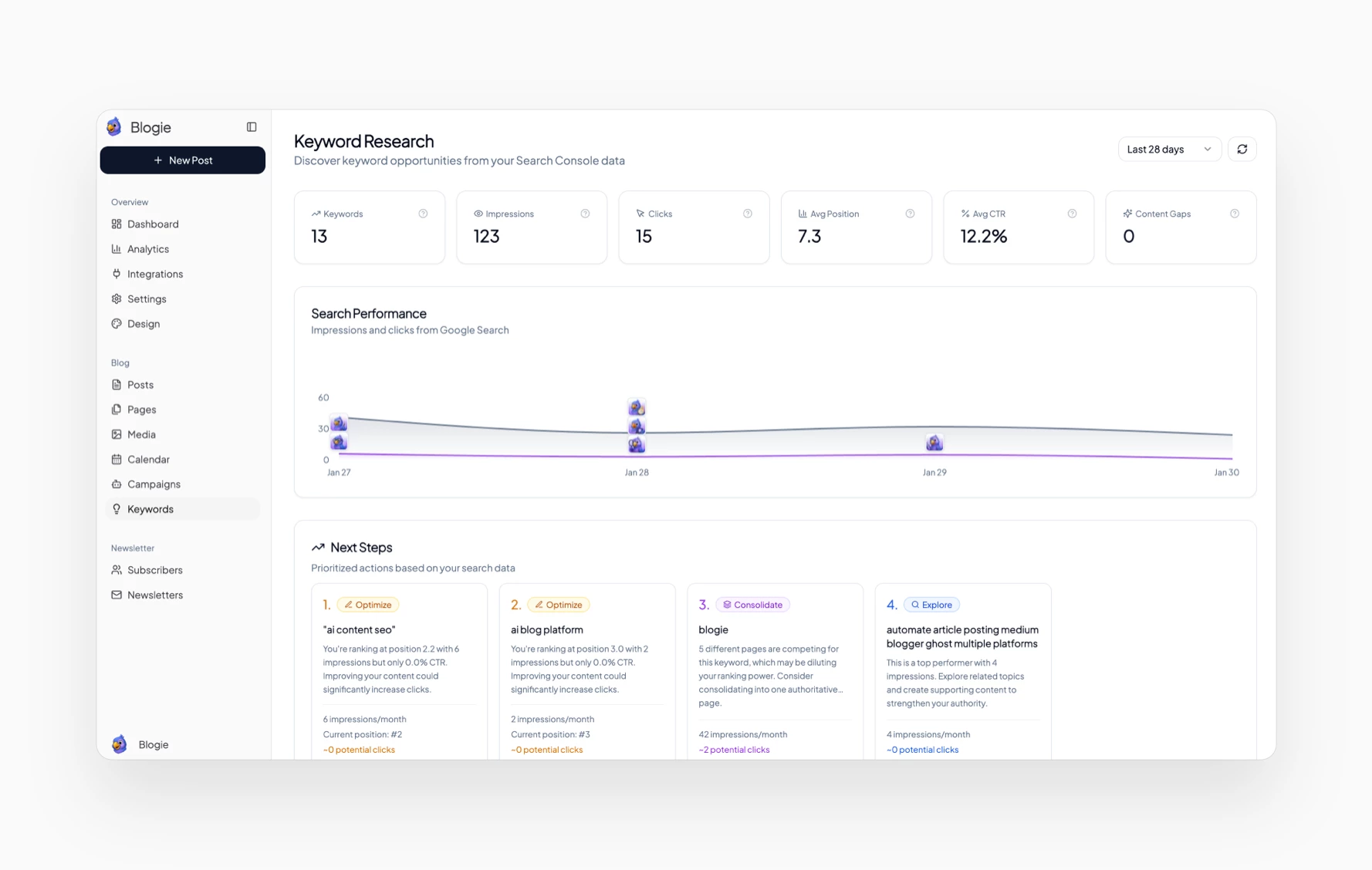
For month one, track: (1) published posts per week, (2) impressions and clicks in Google Search Console, and (3) conversions that matter (email subscribers, trials, demo requests). Pageviews alone can be misleading, especially early on when your best traffic is still ramping up.
Also track your own workflow time: how long it takes to go from idea to published post. The real promise of an AI blogging service explained honestly is speed with control—so if your cycle time isn’t dropping, adjust the process (better briefs, tighter editing checklist, more consistent formatting).
What People Often Wonder About AI Blogging Services

This is the part where most beginner guides get vague, so I’ll be straightforward. When someone asks “AI blogging service explained,” they’re often really asking: “Is this safe? Is it ethical? Will it work for my brand?” The answers are usually “yes, if you do it responsibly,” but the details matter.
Is it plagiarism if AI writes it?
AI-generated text isn’t automatically plagiarism, but it can accidentally mimic common phrasing or reproduce patterns from its training data. The safest approach is to treat AI like a drafting assistant and apply human editing for AI content before publishing. Add original examples, product-specific details, and your own structure choices.
If you’re worried, run an originality check and, more importantly, do a “does this sound like us?” check. In my experience, originality comes less from fancy words and more from specific observations and real workflows.
Will Google penalize AI-written content?
Google’s core stance is about quality and helpfulness, not the tool used to create content. If your AI blog writing produces thin, repetitive pages, you’ll likely struggle—not because it’s AI, but because it’s not useful. If your content is accurate, helpful, and aligned to intent, it can perform well.
The practical risk is scale without review. Publishing 100 low-effort posts fast is a great way to dilute your site’s perceived value. A controlled workflow with editing and topical focus is the safer path.
Can AI write in my brand voice?
Yes, within reason—especially if you give it examples and clear constraints. Brand voice is more than tone; it’s also what you choose to emphasize, what you skip, and the opinions you hold consistently. AI can imitate surface-level style, but you still need to define your “point of view rules.”
This is where all-in-one platforms help because you can refine drafts repeatedly in the same environment. With blogie.ai, you can iterate quickly until the voice feels like your team, not like a template.
How much human editing is enough?
Enough editing means you can confidently attach your name and brand to the post. For most SaaS blogs, that’s: verify claims, add your product’s unique insight, improve examples, and tighten the structure for intent. You don’t need to rewrite every sentence, but you do need to eliminate inaccuracies and generic filler.
A simple rule I use: if a competitor could publish the same post with only a find-and-replace, it needs more human input. That’s the line between “AI-assisted” and “interchangeable.”
Takeaways You Can Use Today to Choose and Start Confidently
You don’t need to overcomplicate this. The fastest path from “AI blogging service explained” curiosity to real publishing results is picking a workflow you’ll actually stick to. Consistency beats intensity, and a slightly imperfect post published weekly beats the “perfect draft” that never leaves your Google Doc.
A short buyer checklist
When you’re comparing options, look for a service that supports the whole loop: research → draft → edit → publish → measure. Make sure it can handle basic SEO structure, lets you control tone, and doesn’t lock you into awkward export/import steps. If it offers scheduling and multi-platform publishing, that’s a real operational win.
Also check for clear revision options and quality expectations. If the product can’t explain how it helps you produce accurate, non-generic content, you’ll end up doing more work than you planned.
Workflow fit: Can you go from idea to published post in one place?
Control: Can you steer structure, tone, and key points reliably?
SEO basics: Titles, meta descriptions, headings, internal linking support.
Editing support: Easy revisions and collaboration, not a one-shot generator.
Publishing: Scheduling, formatting, and distribution features.
A safe minimum workflow for beginners
If you’re new, keep it simple: write a one-paragraph brief, generate a draft, do a fact-check pass, add 2–3 real examples, and publish with clean formatting. Then update the post after two weeks based on what you learn (questions from readers, Search Console queries, or feature updates). That loop is how you turn AI blog writing into an asset instead of noise.
Using an end-to-end platform like Blogie makes this beginner workflow easier because you’re not juggling tools for writing, editing, publishing, emailing subscribers, and checking analytics.
When to upgrade to expert strategy help
If you’ve published consistently for 4–8 weeks and you’re still unsure what to write next, that’s a sign you need strategy more than writing speed. Similarly, if you’re getting impressions but few clicks, you likely need better intent matching and stronger titles. And if you’re getting clicks but no conversions, you need tighter CTAs and better alignment with your product.
The nice part is you can start lean and upgrade later. Get the system running first, then layer in deeper keyword strategy, content audits, and conversion optimization. That’s how an “AI blogging service explained” turns into a real, sustainable publishing engine—one helpful post at a time.
Quick next step: If you want an all-in-one workflow that covers writing, publishing, distribution, and analytics, explore blogie.ai and build your first month plan using the topic cluster approach above. It’s a practical way to write less, publish more, and stay consistent without drowning in tools.
This article was created using Blogie.
This article was created using Blogie.