
Automate Posting to Medium, Blogger & Ghost Easily
 Blogie
Publish Once, Show Up Everywhere (Without Copy-Paste)
If you’ve ever hit “Publish” and then immediately sighed because you still have to re-post the same article on Medium, Blogger, and Ghost… yeah, you’re not alone. The whole point of having multiple platforms is distribution—not triple the work. And if your goal is to automate article posting medium blogger ghost multiple platforms, the win isn’t just saving time. It’s consistency. It’s showing up more often. It’s building compounding reach without living in admin tasks.
What “multi-platform posting” means for Medium, Blogger, and Ghost
Multi-platform posting (a.k.a. cross-posting) is exactly what it sounds like: you write once (your “source of truth”), then automatically publish or distribute that same content to other platforms. In this post, we’re focusing specifically on workflows that help you automate article posting medium blogger ghost multiple platforms—either by pushing full posts to another platform or by distributing links/excerpts so people discover the original.
The core automation patterns: RSS, integrations, and webhooks
Almost every automation you’ll see falls into one of three buckets:
- RSS-based automation: a feed updates when you publish, and that update triggers a post/share somewhere else. Great for “publish and distribute” workflows and often the fastest way to automate article posting medium blogger ghost multiple platforms with minimal setup.
- Direct integrations: a tool already knows how to connect Platform A to Platform B (like Blogger ↔ Medium). These are usually easiest to set up, but can be limited in customization.
- Webhooks: event-based triggers (like “post published”) that can kick off more advanced workflows. They’re powerful, but more “builder mode.”
How this list is organized (tools vs. platform-specific guides)
I’m going to walk through only the verified items you provided—no random tool pile-ons. You’ll get a mix of:
- Dedicated cross-posting tool: BrandGhost
- IFTTT connections: especially strong for Blogger + Medium and RSS
- Zapier options: especially strong for Ghost-centric workflows, webhooks, and multi-step automations
- Platform/community guides: real-world Ghost → Medium discussion and a hands-on Zapier walkthrough
Throughout, I’ll keep it grounded in a practical goal: automate article posting medium blogger ghost multiple platforms in a way that actually sticks (and doesn’t break the moment you change a headline).
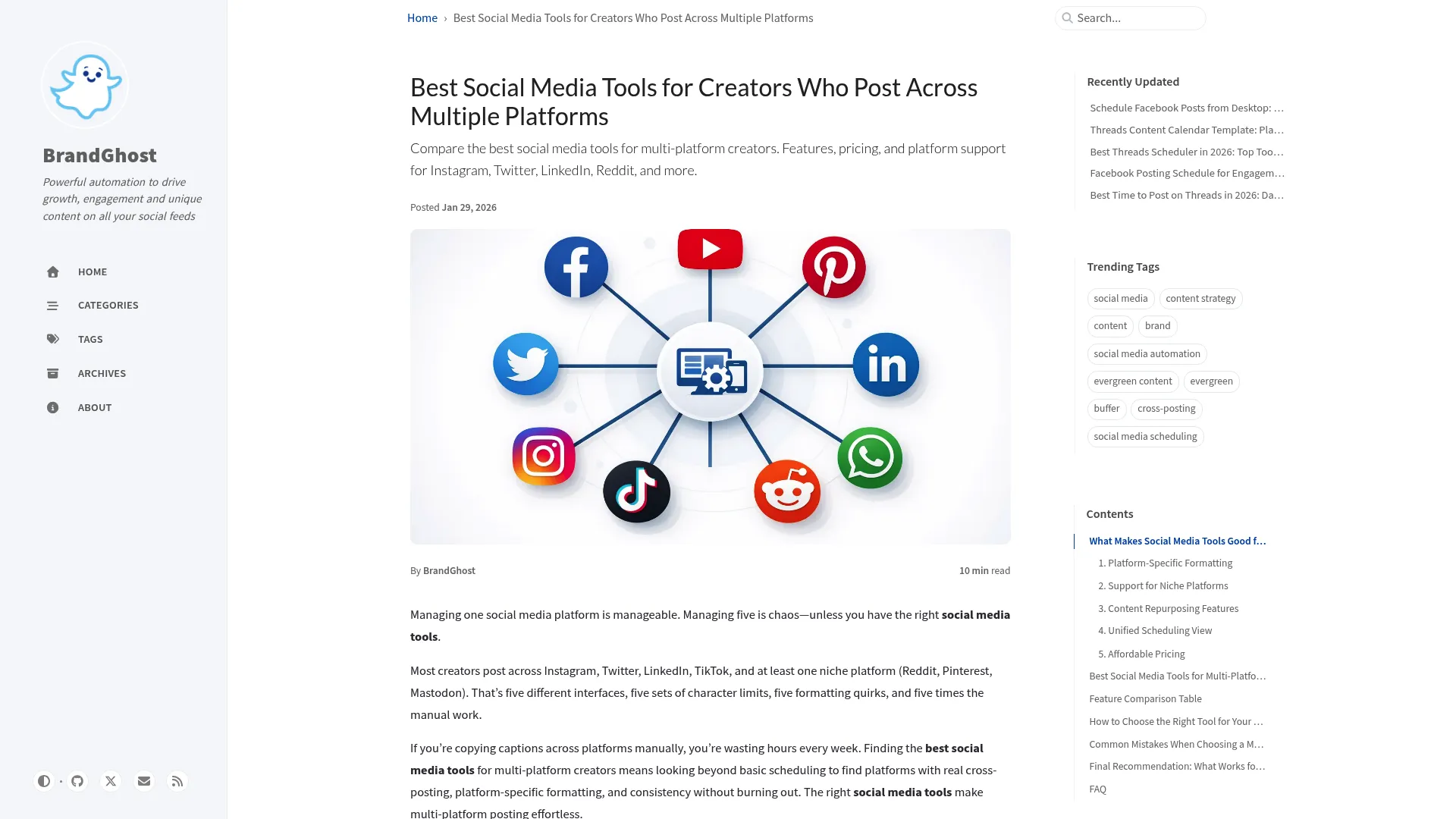
BrandGhost
If your brain immediately goes, “Okay but I don’t just want Medium and Blogger—I want everything,” then BrandGhost is the first item here that’s explicitly positioned for broader distribution. The official reference is BrandGhost’s own post: BrandGhost (Creator: BrandGhost). It’s a paid option and the stated use case is cross-posting to 5+ platforms.
Features: cross-posting to 5+ platforms
What I really like about this positioning is the clarity: it’s not pretending to be just a “zap builder” or a general automation utility. It’s meant to help creators distribute content widely. If your north star is to automate article posting medium blogger ghost multiple platforms as part of a bigger omnichannel workflow, a dedicated tool can be less fiddly than stitching together lots of applets and Zaps.
Use case: multi-platform creator workflow from one source
The most natural way to use a tool like this is to pick one platform as your publishing “home,” then set BrandGhost as your distribution layer. For a SaaS like blogie.ai, that might mean you draft and finalize in Blogie, publish to your primary blog, and then use a cross-poster to push versions out to other platforms where your audience hangs out.
Pros/cons: paid tool tradeoffs for broader distribution
- Pro: Less duct tape. One tool designed for multi-platform creators can be easier to manage than multiple small automations.
- Pro: Better fit when your requirement is “5+ platforms” instead of just one connection.
- Con: It’s paid. If you’re only trying to cross-post Blogger ↔ Medium, IFTTT may be enough.
- Con: Any dedicated cross-posting layer can add a new “point of failure” (if it’s down, distribution pauses).
Who it’s for: creators publishing across many platforms
If you’re serious about syndication and you want to automate article posting medium blogger ghost multiple platforms as a standard operating procedure (not an experiment), BrandGhost is the most directly aligned option in this research list—especially if your content strategy includes multiple destinations beyond the core three we’re focusing on.
IFTTT Connect: Blogger and Medium integrations
If your goal is specifically Blogger ↔ Medium and you want the most straightforward “plug it in and go” setup, IFTTT’s prebuilt connection is the cleanest entry point in the verified research. Here’s the exact page: IFTTT Connect: Blogger and Medium integrations (Creator: IFTTT, Price: Free). It’s explicitly described as automating Blogger↔Medium cross-posting.
Features: prebuilt connection between Blogger and Medium
This is the kind of automation that feels like it was made for normal humans (compliment). Instead of you constructing a workflow from scratch, it’s already framed as a connection between the two platforms. If your top priority is to automate article posting medium blogger ghost multiple platforms but you’re starting with just two platforms, prebuilt is nice because it reduces setup decisions.
Use case: automate Blogger↔Medium cross-posting
A common pattern is:
- Publish on Blogger → automatically create a post on Medium
- Or publish on Medium → automatically create/update something on Blogger (depending on what the connector supports)
For teams using Blogie as the writing engine, you could publish to your “home” destination, then use Blogger as one of your distribution endpoints, and let IFTTT keep Medium in sync. It’s a very “set it once” way to automate article posting medium blogger ghost multiple platforms without needing webhooks or custom code.
Pros/cons: simple setup vs. customization limits
- Pro: Fast setup. Minimal automation theory required.
- Pro: Free, which is honestly a big deal when you’re just proving a workflow.
- Con: Prebuilt connectors can be opinionated. If you want custom formatting rules, conditional logic, or multi-step workflows, you may bump into limits.
Who it’s for: bloggers who only need Blogger + Medium automation
If you’re primarily trying to cross-post Blogger to Medium (or vice versa) and you don’t want to become the “automation person,” this is the easiest win on the list. It won’t solve everything for Ghost, but it’s an excellent start toward automate article posting medium blogger ghost multiple platforms with minimal friction.
IFTTT Blogger integrations
If you’re more of a “Blogger first” publisher and you want lots of small, practical automations around it, the broader integration directory is where you’ll spend time. The verified resource is IFTTT Blogger integrations (Creator: IFTTT, Price: Free). The stated use case is automating Blogger sharing and posting.
Features: applets focused on Blogger triggers/actions
IFTTT’s model tends to be simple: if this happens, then do that. And Blogger integrations are typically built around triggers like “new post published,” then actions like sharing the post elsewhere or creating something based on it. If you’re trying to automate article posting medium blogger ghost multiple platforms, this is where you can make Blogger a reliable source signal that kicks off distribution.
Use case: automate Blogger sharing and posting
One thing I like here is that it’s not only about “full cross-posting.” Sometimes the smarter move is:
- Publish full article on your primary site
- Automatically share a clean link + excerpt to Medium/Blogger/Ghost (or elsewhere) to drive traffic back
That distinction matters because some teams don’t want duplicate full content across platforms (or they want canonical control). Depending on your strategy, “sharing” automations can still support your mission to automate article posting medium blogger ghost multiple platforms.
Pros/cons: lightweight automation vs. advanced workflow constraints
- Pro: Free and lightweight. Great for quick wins.
- Pro: Easy to iterate—turn applets on/off without re-architecting everything.
- Con: If you need multi-step routing, approvals, or rich transformations, IFTTT can feel too “one-step.”
Who it’s for: Blogger users who want quick automations
If Blogger is your core and you want to automate article posting medium blogger ghost multiple platforms in a “keep it simple” way, the Blogger integration hub is the place to start. It’s especially good when you want a handful of automations rather than a single complex workflow.
IFTTT
Zooming out: if you only remember one thing about IFTTT, it’s that it’s often the fastest path to automation when you can model your workflow as “trigger → action.” The verified item is the main platform: IFTTT (Creator: IFTTT, Price: Free). The listed use case is automating posting via RSS and apps—which is exactly where IFTTT can quietly power a lot of “multi-platform posting” behind the scenes.
Features: automate posting via RSS and supported apps
RSS is one of the most underrated tools for people trying to automate article posting medium blogger ghost multiple platforms. If your platform produces a feed (and most blogs do), you can use that feed to trigger automations whenever a new post appears.
For a SaaS content workflow, this pairs nicely with a “publish to one place, distribute everywhere” model. For example, you can treat your main blog as the canonical source, and then use RSS-driven applets to share to other destinations without manual effort.
Use case: connect RSS feeds to publishing/sharing destinations
Here’s a practical framing that works well for teams using blogie.ai as the writing and publishing hub:
- Write and finalize your post in Blogie
- Publish to your primary blog/site (source of truth)
- Use RSS-triggered automations in IFTTT to distribute excerpts/links, or to create posts in connected platforms where supported
This is often the “least fragile” way to automate article posting medium blogger ghost multiple platforms, because RSS is a stable standard and doesn’t depend on you clicking the right button every time.
Pros/cons: broad app ecosystem vs. limitations by service
- Pro: Broad ecosystem. You can connect lots of services without custom code.
- Pro: RSS-first automation is easy to reason about and easy to troubleshoot.
- Con: What you can do depends heavily on what each service exposes to IFTTT (some actions are richer than others).
- Con: If you want very specific formatting transformations, you may feel boxed in.
Who it’s for: anyone wanting RSS-based or app-based automations
If your main objective is to automate article posting medium blogger ghost multiple platforms with as little complexity as possible, IFTTT is the “start here” layer—especially when your strategy is to distribute links/excerpts reliably and consistently.
Zapier Ghost Integrations
When you move from “simple cross-posting” into “real workflows,” Zapier is usually the tool people end up using—especially if Ghost is part of the stack. The verified directory page is Zapier Ghost Integrations (Creator: Zapier, Price: Paid). The use case is automating Ghost workflows to other apps.
Features: Ghost app connections to many other apps in Zapier
Zapier’s strength is breadth plus multi-step logic. So if your definition of automate article posting medium blogger ghost multiple platforms includes things like “when a post is published, then do three actions, then notify the team, then log it,” Zapier is built for that style.
Use case: automate Ghost workflows to other tools/platforms
Ghost is a popular publishing platform for a reason, and automating around it can look like:
- Trigger on Ghost publishing events
- Send content (or a link) to other platforms
- Kick off distribution tasks (social sharing, notifications, internal logging)
If you’re running a content engine and want to automate article posting medium blogger ghost multiple platforms, this is where Ghost becomes a dependable “event source” instead of a place someone has to remember to copy/paste from.
Pros/cons: powerful workflows but paid pricing
- Pro: Multi-step workflows, filters, and logic—much more flexible than simple applets.
- Pro: Great when Ghost is central and you want to integrate it with the rest of your stack.
- Con: It’s paid (per the research item), so you’ll want to be intentional about which automations you run.
- Con: More flexibility means more ways to misconfigure things—testing matters.
Who it’s for: teams needing multi-step Ghost automations
If you’re a team (or a solo operator who thinks like a team) and your goal is to automate article posting medium blogger ghost multiple platforms with reliable process around Ghost, Zapier is the heavy-duty option in this list.
Ghost Forum: Anyway to automatically push post to Medium?

I’m glad this next item is included, because it’s the kind of “reality check” resource that prevents you from chasing a fantasy workflow. The verified thread is Ghost Forum: Anyway to automatically push post to Medium? (Creator: Ghost Forum, Price: Free). It’s not a tool—it’s guidance and discussion around Ghost → Medium automation.
Features: community discussion and practical guidance
Forum threads like this are useful because they surface what people have actually tried, what broke, and what’s possible given platform constraints. If you’re trying to automate article posting medium blogger ghost multiple platforms, the limiting factor is often “what does the platform allow?” not “how clever is my automation?”
Use case: learn options/approaches for Ghost→Medium automation
If you’re specifically interested in Ghost to Medium automation, this thread is a smart early read. It helps you map the landscape:
- Is there a native feature? (Often: no.)
- Do you need a third-party automation tool? (Often: yes.)
- Does RSS help? Do webhooks help? (Sometimes.)
That clarity is what lets you choose between an RSS-based distribution approach and a more direct cross-posting approach.
Pros/cons: real-world context vs. not a turnkey tool
- Pro: Real-world context—people asking the exact question you have.
- Pro: Helps you avoid spending hours building a workflow that can’t work as imagined.
- Con: It won’t “do” anything by itself; it’s guidance, not automation.
Who it’s for: Ghost users evaluating feasible automation paths
If Ghost is part of your stack and you want to automate article posting medium blogger ghost multiple platforms, read this before you commit. Think of it as your feasibility filter—especially for Ghost → Medium questions.
How to automate Ghost/Medium cross-posting via Zapier
This is the hands-on “show me how” companion to the Ghost forum discussion. The verified tutorial is How to automate Ghost/Medium cross-posting via Zapier (Creator: Unknown, Price: Free). It’s explicitly a tutorial for Ghost → Medium automation using Zapier.
Features: step-by-step tutorial format for Zapier-based setup
What I appreciate about a step-by-step guide (when you’re trying to automate article posting medium blogger ghost multiple platforms) is that it forces specificity. “Use Zapier” can mean a thousand different workflows. A tutorial nails down a concrete path you can replicate, test, and then adapt.
Use case: implement Ghost→Medium automation using Zapier
This is specifically useful if:
- You publish in Ghost
- You want posts to appear on Medium with minimal manual work
- You’re okay implementing a Zapier-based approach (and doing the follow-through)
Even if your end-goal is broader—like automate article posting medium blogger ghost multiple platforms—it’s often smartest to solve one lane first (Ghost → Medium), then expand to Blogger or other targets once you’ve verified formatting, excerpts, and links behave as expected.
Pros/cons: hands-on walkthrough vs. requires technical follow-through
- Pro: Practical blueprint. You’re not guessing what to click.
- Pro: Great for DIY folks who want to understand the mechanics.
- Con: You still have to implement it carefully. Tutorials don’t account for every edge case in your setup.
- Con: If you’re not comfortable troubleshooting automations, you may prefer a more packaged approach.
Who it’s for: DIY users who want a tutorial to replicate
If you’re the type who wants to understand your system—not just click “connect”—this guide is a solid bridge into Zapier Ghost integrations and a practical step toward automate article posting medium blogger ghost multiple platforms without relying on guesswork.
Zapier Community: Share your blog posts beautifully across social media
This Zapier Community article is less about “publish the full post on another blogging platform” and more about automated distribution—getting your posts out into the world consistently using RSS. The verified resource is Zapier Community: Share your blog posts beautifully across social media (Creator: Zapier, Price: Free). The stated use case is automating sharing Ghost posts using RSS.
Features: community article describing RSS-based sharing approach
RSS-based distribution is one of those “boring but brilliant” tactics. It’s not flashy, but it’s reliable. And if your objective is to automate article posting medium blogger ghost multiple platforms, you don’t always need full cross-posting to win—you sometimes just need consistent visibility.
Use case: automate sharing Ghost posts using RSS
This approach fits especially well when:
- You publish on Ghost
- You want consistent promotion triggered by your publishing schedule
- You want posts shared out quickly without manual steps
Even if the end destination isn’t Medium or Blogger specifically, learning the RSS-driven “publish → share” model is valuable because it’s the same core pattern you’d apply when building a system to automate article posting medium blogger ghost multiple platforms across your full distribution mix.
Pros/cons: good for distribution/sharing vs. may not equal full cross-posting
- Pro: Excellent for promotion and distribution—helps you stay consistent.
- Pro: RSS triggers tend to be stable and easy to audit.
- Con: Sharing isn’t the same thing as full cross-posting. If you need complete posts mirrored on Medium/Blogger, you’ll likely need a more direct workflow.
Who it’s for: creators wanting automated social promotion from blog/RSS
If your bigger plan to automate article posting medium blogger ghost multiple platforms includes “don’t forget to promote,” this resource is the reminder that distribution automation can be just as important as syndication automation.
Zapier: Ghost Webhooks by Zapier Integration - Quick Connect
Now we’re getting into the “power tools” section. The verified item is Zapier: Ghost Webhooks by Zapier Integration - Quick Connect (Creator: Zapier, Price: Paid). The stated use case: trigger automations from Ghost webhooks.
Features: trigger Zaps from Ghost webhooks
Webhooks are how you make workflows feel instant. Instead of waiting for a feed to refresh, a webhook is an event: “this just happened.” If you’re trying to automate article posting medium blogger ghost multiple platforms and you care about speed, webhooks are a strong option.
Use case: webhook-driven automations from Ghost events
Here’s what a webhook-driven approach can enable in practice:
- A post is published in Ghost → a Zap triggers immediately
- The Zap can route the post data to another platform, queue a distribution step, or kick off internal workflows
This is especially useful for teams where “publish” is the start of a chain reaction: distribution, notifications, logging, and so on. If you’re building a robust system to automate article posting medium blogger ghost multiple platforms, webhooks can be the backbone that makes it feel seamless.
Pros/cons: flexible real-time triggers but paid pricing
- Pro: Real-time(ish) behavior. Great when timing matters.
- Pro: Flexibility—webhooks can carry structured data that’s useful for downstream steps.
- Con: Paid pricing (per the verified item), so it’s best when you truly need webhook-level control.
- Con: More moving parts means you should test carefully and monitor failures.
Who it’s for: advanced users who want event-based Ghost automations
If RSS feels too slow or too limited, and you want a more “systems” approach to automate article posting medium blogger ghost multiple platforms, this Zapier + Ghost webhooks option is the advanced lane.
Zapier: New for Our Ghost Integration: Automatically Create Posts ...

This item is a bit different from the others because it focuses on automating content into Ghost (instead of out of Ghost). The verified update post is Zapier: New for Our Ghost Integration: Automatically Create Posts ... (Creator: Zapier, Price: Free). The use case is automating creating posts in Ghost.
Features: Zapier action to automatically create posts in Ghost
If you’re treating Ghost as one of your publishing endpoints, the ability to automatically create Ghost posts becomes super relevant. For example: you publish somewhere else (your canonical platform), then use Zapier to create a corresponding post in Ghost. That’s a direct way to automate article posting medium blogger ghost multiple platforms when Ghost is part of your distribution mix.
Use case: automate creating posts in Ghost from another source
In a “one source, many destinations” workflow, this supports patterns like:
- Publish your main article on your primary blog
- Trigger a Zap that creates a Ghost post (full or partial, depending on your setup)
For a content engine built around speed—like what Blogie aims for—this kind of inbound automation is appealing. You don’t want writers manually recreating posts across platforms. You want the system to automate article posting medium blogger ghost multiple platforms while humans focus on content quality.
Pros/cons: useful for inbound automation vs. dependent on Zap design
- Pro: Makes Ghost a viable endpoint in a multi-platform system.
- Pro: Can reduce manual duplication if Ghost is one of your required publishing channels.
- Con: The quality of the result depends on how you design the Zap (formatting, excerpts, tags, etc.).
Who it’s for: publishers syncing content into Ghost
If Ghost is not your “source of truth” but you still want it in your distribution footprint, this update is the piece that makes that workflow more realistic—and it contributes directly to your ability to automate article posting medium blogger ghost multiple platforms without extra manual steps.
Choosing Your Automation Path (RSS vs. Integrations vs. Webhooks)
Once you’ve seen the landscape, the real question becomes: which path should you commit to first? If you’re trying to automate article posting medium blogger ghost multiple platforms, your best choice depends less on “what’s possible” and more on how complex your needs really are.
When to use IFTTT for simple Blogger/Medium workflows
If your main pain is Blogger and Medium, IFTTT is hard to beat for speed and simplicity:
- Use the prebuilt connection: IFTTT Connect: Blogger and Medium integrations
- Browse related options in: IFTTT Blogger integrations
- For RSS-driven distribution across apps: IFTTT
Use this path if you want to automate article posting medium blogger ghost multiple platforms with minimal configuration and you’re okay with “good enough” customization.
When to use Zapier for Ghost-centric multi-step automations
If Ghost is central—or if you want multi-step automation logic—Zapier is the more flexible choice:
- Start at: Zapier Ghost Integrations
- For event-driven triggers, consider: Zapier: Ghost Webhooks by Zapier Integration - Quick Connect
- If you need to create Ghost posts from another source: Zapier: New for Our Ghost Integration: Automatically Create Posts ...
This is the path when you’re serious about Zapier Ghost integrations and want to automate article posting medium blogger ghost multiple platforms with workflow depth (filters, routing, multi-step actions).
When to choose a dedicated multi-platform tool for 5+ platforms
If you’re aiming beyond just Medium/Blogger/Ghost and you want a distribution layer made for creators, look at BrandGhost. The research calls out its cross-posting use case for 5+ platforms, and it’s paid—so I’d choose it when the ROI is clear: you’re publishing frequently enough that manual distribution is a measurable drag.
In other words: if your real requirement is “multi-platform content publishing tools that scale,” this is the most purpose-built item in the list for that.
Your Next Steps: Set Up, Test, and Scale Your Cross-Posting
The fastest way to fail at automation is to automate everything at once. The fastest way to succeed at automate article posting medium blogger ghost multiple platforms is to start embarrassingly small, then scale once you’ve proven formatting and reliability.
Pick one “source of truth” platform and one distribution target to start
Choose your canonical home first (where the final, best version lives). For many SaaS teams, that’s the primary blog on your domain—especially if SEO matters and you want full control. If you’re using blogie.ai to write and publish quickly, make that your consistent starting point, then pick one destination to automate next (Medium or Blogger or Ghost).
Run a small test (one post) and verify formatting/links
Do a single-post test run and check:
- Does the title come through correctly?
- Are links intact (especially internal links back to your site)?
- Do images behave the way you expect?
- Is the excerpt or first paragraph clean, or does it need tweaking?
This is where you’ll catch the little things that make cross-posts look sloppy. If you’re trying to automate article posting medium blogger ghost multiple platforms, quality control is the difference between “automated growth” and “automated mess.”
Expand to more platforms once the first automation is stable
Once one route is stable, add the next:
- For Blogger ↔ Medium, scale using: IFTTT Connect: Blogger and Medium integrations
- For Ghost workflows, scale using: Zapier Ghost Integrations and (if needed) Zapier: Ghost Webhooks by Zapier Integration - Quick Connect
- If you’re publishing everywhere, consider a dedicated layer like: BrandGhost
One thing to watch out for: the more you scale, the more you need a repeatable checklist. That’s why “publish once, distribute many” systems work best when your writing and publishing process is already streamlined—exactly the kind of workflow Blogie is built to support.
And if you’re keeping score: the whole point is to automate article posting medium blogger ghost multiple platforms enough that your publishing cadence is limited by ideas—not by tabs, logins, and copy-paste.
This article was created using Blogie.
This article was created using Blogie.