
From Idea to Published Post: How Automated Blogging Works
 Blogie
Introduction: What “Automated Blogging” Really Means
Automated blogging is a structured way to move from a raw topic to a publish-ready article using software-assisted steps—research, outlining, drafting, editing, and publishing—without manually juggling a dozen tabs. The goal is not to “press one button and rank,” but to reduce repetitive work so you can publish more often with consistent quality. When done well, automated blogging turns content production into a repeatable system rather than a one-off creative sprint.
From rough idea to finished draft
Most posts start as a messy note: a customer question, a new product feature, or a trend you noticed in analytics. An automated blogging pipeline turns that note into a draft by progressively adding clarity—audience, intent, keywords, structure, and examples—so the writing becomes easier and more predictable. Instead of “write a blog post,” you’re executing smaller steps that produce specific outputs.
Automation vs. autopilot: where humans still matter
Automation handles the repeatable parts: gathering SERP patterns, suggesting headings, generating variations, formatting, and preparing a CMS-ready draft. Humans still matter for the parts that create trust: picking an opinionated angle, adding original examples, validating claims, and making brand voice feel consistent. Strong automated blogging keeps you in control of decisions while software accelerates execution.
What this guide will help you implement
This guide maps the full AI blog writing workflow from idea to publish, including keyword research automation, outline generation, drafting with accuracy safeguards, and a clean review loop. You’ll also see how multi-platform blog publishing can be built into the process so a single approved article becomes a website post, newsletter segment, and social snippets. The aim is simple: ship faster while raising the floor on quality.

Start Blogging with Blogie AI
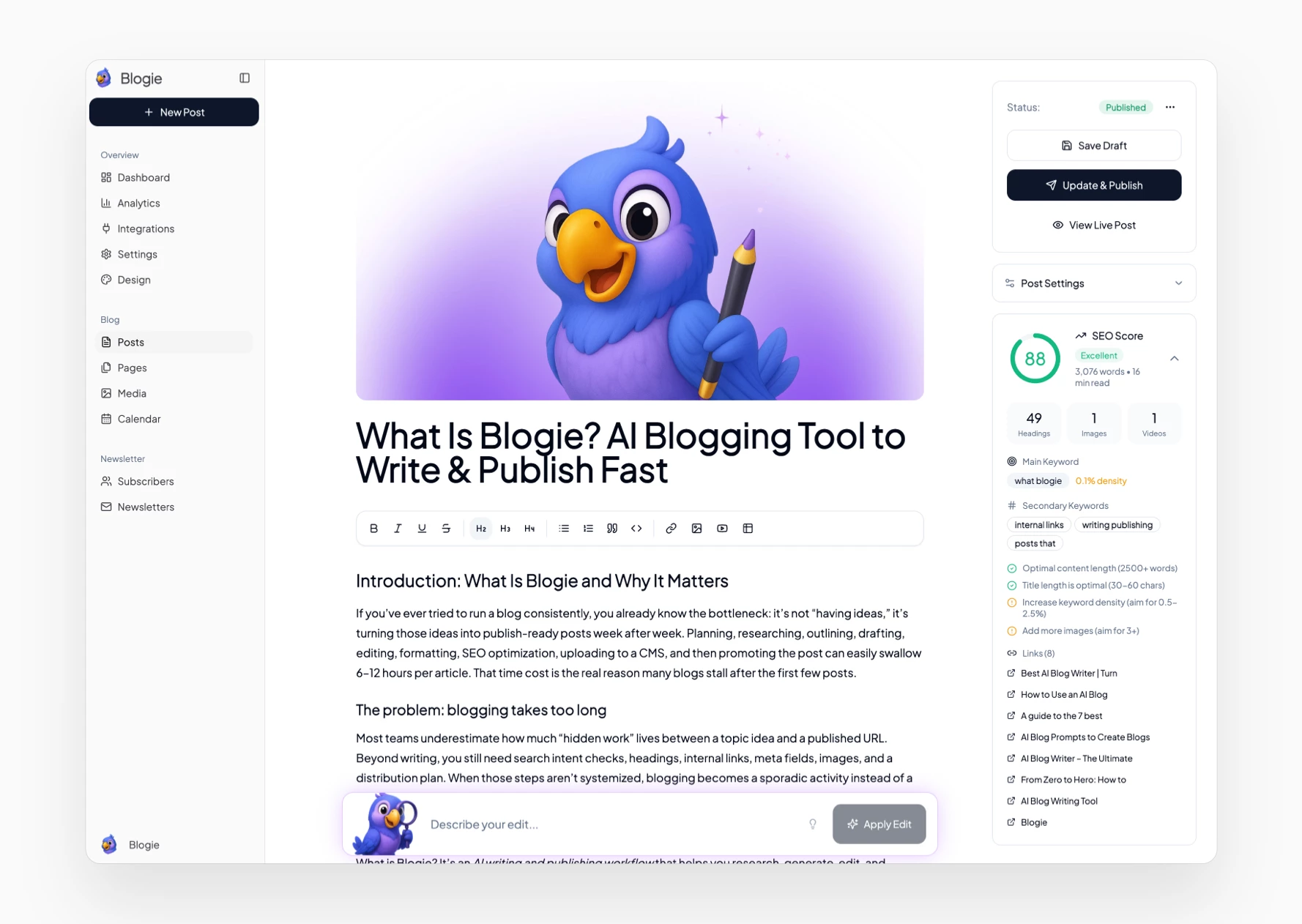
If you're ready to elevate your blogging game, look no further than Blogie AI. This comprehensive platform offers everything you need to streamline your blogging process, from AI-driven writing to final publishing. With Blogie, you can manage not only your content creation but also your analytics and newsletters, ensuring that your blog reaches its full potential.
Blogie handles the entire workflow, allowing you to focus on what you do best: creating engaging content. Whether you're a seasoned blogger or just starting out, Blogie's intuitive interface and powerful tools will help you save time and enhance your productivity. Dive into the future of blogging today and discover how automated solutions can transform your writing journey.
The End-to-End Workflow: Idea → Research → Draft → Publish
A modern automated blogging system looks like an assembly line—except you can pause, review, and improve at every station. The real advantage is throughput: fewer bottlenecks between “We should write about this” and “It’s live, indexed, and being shared.” If you treat content like an operation (not a burst of inspiration), you can publish on a schedule without lowering standards.
Typical stages in a modern content pipeline
Most automated content creation pipelines follow a predictable sequence: ideation, content brief, keyword mapping, outline, draft, edit, SEO polish, and publication. Each stage produces an artifact (brief, outline, draft) that can be reviewed, versioned, and reused for future posts. This makes automated blogging easier to manage than “start from scratch” writing.
How integrated workflows replace tool switching
Traditional stacks often require jumping between SEO tools, docs, editors, and CMS screens, which adds friction and causes mistakes. Integrated automated blogging workflows reduce that switching by keeping research, drafting, and formatting in one place, so context doesn’t get lost. For a broader view of how AI systems connect these steps, see The complete guide to AI blog.
Where quality control fits in
Quality control is not a final checkbox; it belongs in multiple stages—brief review before drafting, outline review before writing, and factual verification before publishing. The best AI blog writing workflow includes “gates” where a human approves direction, checks claims, and ensures the article matches brand positioning. Automated blogging works best when automation speeds up production and humans protect credibility.

Step 1 — Turning a Simple Idea Into a Clear Content Brief
A strong brief is the difference between a useful article and 2,000 words of vague filler. In automated blogging, the brief is the control document: it tells the system what to produce and what to avoid. If you want consistent output from automated content creation, make the brief a habit, not an optional step.
Inputs that work best: audience, goal, angle
Start with three inputs: who the reader is, what outcome you want (subscribe, request a demo, understand a concept), and what unique angle you’ll take. Even one sentence per input is enough to guide tone, examples, and depth. Tools that support automated blogging often let you store these inputs as presets, similar to what you’ll find in ContentBot - AI Content Automation and.
Choosing search intent and the “one job” of the post
Every post should do one primary job: explain, compare, recommend, or teach a process the reader can apply. Selecting intent prevents the draft from mixing incompatible formats (like trying to be both a glossary and a product landing page). Automated blogging becomes more reliable when each article has one clear promise and delivers on it fully.
Defining scope to avoid thin or bloated articles
Scope boundaries prevent two common failures: thin posts that don’t answer real questions, and bloated posts that wander into unrelated topics. Define what you will cover, what you will not cover, and what “done” looks like (e.g., 8 sections, 1 comparison table, 3 real examples). This keeps automated content creation focused, readable, and easier to edit.

Step 2 — Keyword Research Automation That Still Feels Human
Keyword research automation can surface patterns fast, but it needs a human filter so the final article reads naturally and matches your brand. The goal is not to cram terms into paragraphs; it’s to match language your audience already uses when searching. When automated blogging is paired with smart keyword choices, your content can rank while still sounding like a person wrote it for other people.
Primary keyword selection and related terms
Start with a primary keyword that matches your post’s intent—here, that might literally be “automated blogging”—then collect related terms that reflect sub-questions and variations. A good rule is to pick 6–12 related phrases you can use naturally in headings or examples, rather than repeating the same term excessively. For a practical walkthrough of automating parts of this process, reference Automate Blog Writing with AI: A.
Topic clustering and supporting subtopics
Topic clustering connects one primary article to supporting posts that answer narrower questions, like “keyword research automation,” “editorial review loops,” or “multi-platform blog publishing.” Automation can suggest clusters by analyzing SERP overlaps and “people also ask” themes, but you decide what fits your product and audience. Over time, automated blogging becomes more effective because each post strengthens the internal linking network.
How to balance SEO with readability
Use keywords where they help comprehension: titles, headings, definitions, and short recap lines—then prioritize clarity everywhere else. If a sentence feels forced, rewrite it and let the keyword appear later in a more natural spot. The best automated content creation outputs sound like guidance from a competent editor, not a list of search terms.

Step 3 — Auto-Structuring: Building an Outline That Converts
An outline is where automated blogging shifts from “generating text” to “designing an experience.” Readers skim before they commit, so structure is what earns attention and keeps it. A conversion-focused outline anticipates objections, adds proof at the right moment, and gives readers a next step that feels helpful instead of pushy.
Mapping headings to intent and scanning behavior
Headings should mirror the reader’s mental checklist: definition, benefits, how it works, pitfalls, and next steps. Automated blogging tools can propose headings based on top-ranking patterns, but you should reorder them based on your audience’s priorities and your offer. The goal is for someone skimming H2s and H3s to understand the entire argument in under 30 seconds.
Where to place examples, proof, and CTAs
Examples belong immediately after complex ideas, because abstract explanations are where readers drop off. Proof can include short process details, concrete numbers from your operations (time saved, steps reduced), and mini case-style scenarios. For outline patterns used in automated blogging, see Automated Blog Posting for Beginners A, and then adapt the CTA placement to your funnel stage.
Creating consistent templates for repeatable quality
Templates reduce variance: every post can include a definition section, a step-by-step section, a comparison table, and a mistakes section. This consistency is especially valuable in automated content creation because it gives the system predictable slots for information and makes reviews faster. Over time, automated blogging becomes a “house style” that readers recognize and trust.
Step 4 — Content Generation: Drafting With Voice and Accuracy
Drafting is where speed gains are most visible, but it’s also where quality risks show up if you don’t set constraints. A good AI blog writing workflow produces drafts that are structurally sound, on-brand, and specific enough to be edited quickly. The objective is not “publish the first draft,” but “publish a draft that’s 70–85% there so humans can polish the final 15–30%.”
How AI drafting works in practice (inputs, constraints, outputs)
Effective drafting starts with inputs: the brief, target audience, primary keyword, related terms, outline, and examples you want included. Constraints define what “good” means—word ranges per section, tone, reading level, and forbidden claims (like unsupported statistics). Systems that specialize in automated blogging often model this as a repeatable job, similar to the approaches described in AI Agents for Blog Content: A.
Maintaining brand voice and “human-sounding” writing
Brand voice comes from choices: short vs. long sentences, how often you use lists, whether you favor direct advice or exploratory explanation. Save example paragraphs that match your voice and feed them into your workflow as reference text, then instruct the system to follow that style without copying phrases. Automated content creation improves when “voice rules” are explicit, not assumed.
Reducing hallucinations: sourcing, specificity, and verification
Hallucinations happen when a model fills gaps with plausible-sounding details, so your workflow should reduce opportunities for guesswork. Ask for specific, checkable statements, avoid invented studies, and require that any numbers be either provided by you or marked for verification. Automated blogging stays credible when you treat drafts as hypotheses that must be confirmed before publication.

Step 5 — Editing and Refinement in a Clean Review Loop
Editing is where automated blogging becomes publishable blogging. The draft’s job is to get the structure and substance onto the page; the editor’s job is to make it sharp, accurate, and easy to consume. A clean review loop also prevents endless “tweak cycles” by assigning clear responsibilities and checkpoints.
Tightening structure: intros, transitions, and conclusions
A strong intro states the problem, the outcome, and what the reader will learn—without long warm-up paragraphs. Transitions should explain why the next section matters, so the article feels like one connected argument rather than separate notes. Conclusions work best when they recap the method and give one clear next action tied to the reader’s goal.
Improving clarity: reading level, jargon, and examples
Clarity comes from replacing vague terms (“optimize,” “leverage,” “robust”) with actions and outcomes (e.g., “reduce editing time from 45 minutes to 15”). If jargon is necessary, define it once and reuse the same definition consistently across posts. Automated blogging drafts often improve quickly when you add one concrete example per major concept.
On-page SEO checks: titles, meta descriptions, internal links
On-page SEO is a checklist, not a guessing game: confirm the title matches intent, the meta description is under typical snippet limits, and headings reflect your target queries. Add internal links to relevant supporting posts and product pages so search engines understand topical relationships. This final step turns automated content creation into content that’s easier to discover and navigate.
Blogie in Practice: One Workflow From Prompt to Post
Blogie-style automated blogging works best when the workflow feels like a conversation, not a complicated configuration. You describe what you want in plain language, the system proposes research-backed structure and keywords, and you approve or adjust before drafting. That approach keeps speed high without sacrificing your control over positioning and accuracy.
Describe your idea in plain language
Start with a prompt that includes the topic, audience, and the outcome you want, such as “Explain automated blogging to SaaS marketers and show a step-by-step workflow they can copy.” Add any must-include points: your product differentiators, your editorial rules, and examples you want referenced. Plain-language inputs are powerful because they reduce ambiguity early, when changes are cheapest.
Blogie handles research, keywords, and structuring
From that prompt, Blogie can translate your intent into an AI blog writing workflow: suggested keywords, a topic cluster, an outline with section word ranges, and recommended CTAs. The advantage is continuity—research insights flow directly into the outline and draft instead of being lost in tool switching. This is where automated content creation becomes operational rather than experimental.
Review, refine, and finalize in the editor
Before publishing, you review for positioning, add original details (your process, numbers you can verify, customer language), and remove anything generic. Then you run a final pass for readability, on-page SEO, and consistency with other posts in the cluster. Automated blogging works when the editor step is fast because the draft is already structured correctly.
Comparison: Automated Blogging vs. Traditional Tool Stacks
Automated blogging is often compared to “manual” blogging, but the more accurate comparison is automated workflows versus fragmented tool stacks. The question is not whether humans write; it’s whether your process is integrated, repeatable, and measurable. When you evaluate approaches side by side, the operational differences become obvious.
Time-to-publish and operational complexity
Traditional stacks slow down because each step requires context switching: SEO research in one tool, outlining in docs, drafting elsewhere, then formatting and uploading in the CMS. Automated blogging reduces those handoffs by keeping artifacts connected, so you can move from brief to draft to publish with fewer copy-paste errors. In practice, many teams see time-to-publish shrink because approvals happen on the same structured objects (brief, outline, draft).
Consistency, collaboration, and governance
Consistency is hard when everyone has their own process, templates, and SEO habits. Automated content creation systems make governance easier because you can enforce rules: required sections, brand voice constraints, banned claims, and review stages. For collaboration, automated blogging also creates a shared source of truth—everyone edits the same structured draft rather than passing versions around.
Cost trade-offs and when manual still wins
Automation can lower cost per article when it reduces hours spent on research, formatting, and first drafts, but it’s not free—you’re paying in software plus editorial oversight. Manual writing can still win for high-stakes thought leadership, investigative pieces, or posts requiring deep subject-matter interviews. The most effective teams use automated blogging for scale while reserving manual effort for content that must be uniquely original.
Factor | Automated Blogging Workflow | Traditional Tool Stack |
|---|---|---|
Draft speed | Fast first draft with repeatable inputs and templates | Slower, often starts from a blank page |
Process consistency | High (brief/outline gates, reusable templates) | Variable (depends on the writer/editor) |
Quality control | Built-in checkpoints; easier to enforce standards | Often ad hoc; standards live in people’s heads |
Best use case | Scaling content libraries with dependable quality | Deep thought leadership and bespoke narratives |
Common Mistakes That Hurt Quality (and How to Avoid Them)

Automated blogging can amplify both strengths and weaknesses. If your workflow is disciplined, you publish faster with fewer errors; if it’s sloppy, you publish faster with more errors. The mistakes below show up frequently in automated content creation—and they’re all preventable with the right checkpoints.
Publishing without fact-checking or specificity
The fastest way to lose trust is to publish claims that are wrong, unverified, or too vague to be useful. Treat any statistic, tool capability, or “best practice” claim as a citation request: either provide a source, replace it with your own verified numbers, or remove it. Automated blogging should speed up drafting, not bypass editorial responsibility.
Over-optimizing for keywords and losing the reader
Keyword stuffing often happens when teams track keyword frequency instead of reader comprehension. Keep the primary keyword present in the title, early definition, a few headings, and naturally across the body—then focus on explaining the topic clearly. In automated blogging, readability is the ranking strategy because engagement signals and backlinks come from usefulness.
Skipping differentiation: why your post must add something new
If your article repeats what the top five results already say, it has no reason to rank and no reason to be shared. Add differentiation through original frameworks, checklists, templates, firsthand workflows, or specific trade-offs you’ve learned from publishing. Automated content creation becomes truly valuable when it amplifies your unique expertise instead of producing generic summaries.
Real-World Scenarios: Where Automated Blogging Fits Best
Automated blogging is not one-size-fits-all; it’s best viewed as a set of capabilities you can apply to different operating models. The more your success depends on publishing consistently, the more leverage you get from automation. These scenarios show where automated content creation typically delivers the strongest ROI.
Solo creators shipping consistently
Solo creators often know what to say, but they get stuck on the time cost: research, outlining, formatting, and optimization. Automated blogging helps by turning content into a weekly system—brief, outline, draft, edit—so you can publish reliably without burning weekends. It also supports multi-platform blog publishing by repurposing one post into an email and social breakdowns.
Marketing teams scaling content libraries
Teams scaling SEO content need consistency across writers, categories, and product lines, which is hard when everyone works differently. An AI blog writing workflow with templates and checkpoints ensures every article hits required sections, includes internal links, and matches brand voice. Automated blogging also makes it easier to plan topic clusters so new posts strengthen existing rankings.
Agencies delivering repeatable client outcomes
Agencies succeed when they can deliver predictable outputs: briefs, drafts, publishing schedules, and performance reporting. Automated content creation reduces the time spent on admin work (formatting, uploading, status updates) and helps standardize editorial quality across accounts. Automated blogging also supports governance needs—approval trails, consistent tone, and documented processes clients can trust.
CTA + FAQ: Start Using Automated Blogging the Right Way
If you want automated blogging to produce results you can stand behind, start small, measure the workflow, and then scale. Your first goal is a repeatable process that ships one excellent post end-to-end. Once the system works, increasing volume becomes a scheduling problem rather than a creative crisis.
A simple checklist to publish your first automated post
Use this checklist to keep your automated blogging process tight and reviewable, especially for your first few runs. Each step should produce a clear output you can approve before moving forward, which makes quality easier to control. A practical first target is one post per week for four weeks, then refine based on what editing took the longest.
Idea → Brief: audience, intent, angle, and “one job” of the post
Keyword research automation: primary keyword + 8–12 related terms
Outline: headings mapped to intent, with example slots and CTA placement
Draft: generate with constraints (tone, section lengths, must-include details)
Edit: clarity, structure, differentiation, and verification of claims
SEO pass: title, meta description, internal links, image alt text notes
Publish: CMS formatting + indexability checks + share plan
FAQ: originality, SEO risk, and disclosure
Is automated blogging “original”? It can be, but originality depends on your inputs—your examples, your opinions, your data, and your editorial choices. Is there SEO risk? The risk comes from thin, repetitive content and unverified claims, not from using automation as part of the process. Should you disclose AI use? If your audience values transparency, a simple note about using automation for drafting and humans for review can build trust.
FAQ: multi-platform publishing and subscriber notifications
Can I publish the same post everywhere? Yes, but adjust the format: shorten intros for newsletters, turn key sections into threads, and keep the canonical version on your blog for SEO. Multi-platform blog publishing works best when your workflow automatically generates channel-specific excerpts, titles, and CTAs. How do notifications fit in? After publishing, trigger subscriber emails, RSS updates, and social scheduling so distribution is as systematic as creation.
Keyword usage note: As you implement automated blogging, track outcomes like time-to-publish, edits required per draft, and organic impressions per post. Automated blogging becomes more effective when you treat it as a measurable system: improve the brief, tighten the outline template, and refine the review loop each week. Over time, automated blogging supports a sustainable cadence, while automated blogging paired with human review protects quality; that combination is what makes automated blogging scalable without becoming spammy.
This article was created using Blogie.
This article was created using Blogie.