
How AI Helps You Write Better Blog Posts Naturally
 Blogie
Introduction: Faster Writing, Still Human

If you’ve ever asked an AI tool to write a post and felt your stomach drop at the result, you’re not alone. The output is often “correct,” but it reads like it was assembled from interchangeable parts: smooth transitions, safe claims, and a polite tone that never takes a risk. That’s the exact opposite of what you need if your goal is to write better blog posts without sounding like AI.
Why AI drafts often feel robotic
Most AI drafts feel robotic because they optimize for average language, not personal judgment. The model predicts what text is statistically likely to come next, so it tends to produce familiar phrasing, balanced-but-bland statements, and repeated patterns. When you publish that unedited, readers sense “template writing,” even if they can’t explain why.
What “human-sounding” actually means
Human-sounding doesn’t mean messy or unprofessional; it means intentional. A human voice shows preferences, stakes, and specificity: the small details you noticed, the trade-offs you chose, and the examples you’ve actually seen work. To write better blog posts without sounding like AI, you need clarity plus a point of view, not just grammatically clean paragraphs.
What you’ll learn in this guide
This guide gives you a practical AI writing workflow that uses AI where it’s strong (speed, organization, iteration) while protecting what makes your writing yours (angle, experience, voice). You’ll learn how to build a “notes-first” brief, outline like an editor, draft fast, and then edit AI text to sound human. By the end, you’ll be able to write better blog posts without sounding like AI consistently—and publish faster without sacrificing credibility.
Use AI as an assistant, not an author
Ground the post with real examples and constraints
Rewrite for voice with a repeatable checklist
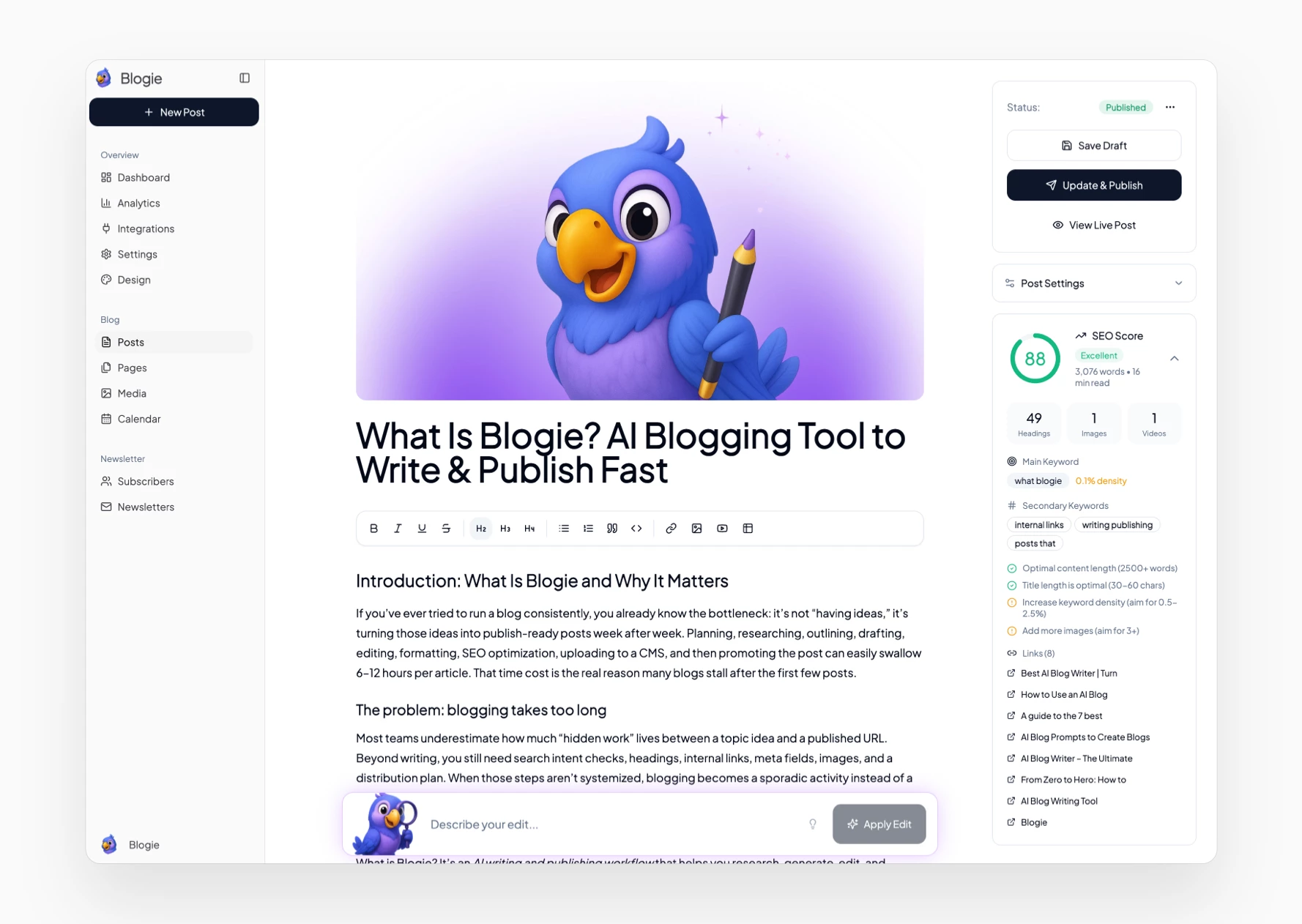
Try Blogging with Blogie AI
If you're looking to elevate your blogging experience, consider exploring Blogie AI at www.blogie.ai. This AI-powered blogging platform is designed to streamline the writing process, allowing you to focus on your ideas without getting bogged down by distractions or complexity.
Blogie AI not only facilitates effortless writing but also assists in publishing and distributing your blog posts. With intuitive features tailored for bloggers, you can enhance your content creation process and achieve a polished final product more efficiently. Dive into a world where technology aids your creativity, enabling you to share your voice with ease.
Authority: What Research Says About AI and Writing
AI can help you write faster, but speed isn’t the same as quality. The strongest results come when writers treat AI as a collaborator that compresses busywork, not as a replacement for thinking. If your goal is to write better blog posts without sounding like AI, it helps to be honest about what AI is good at—and where it predictably falls apart.
AI’s strengths: speed, patterns, summarization
AI excels at accelerating the “first 60%” of writing: brainstorming angles, summarizing sources, generating variations of headlines, and turning bullet points into readable paragraphs. It’s especially useful when you already have a clear thesis and need help expanding subpoints consistently. Many blogging platforms now discuss AI in exactly this supporting role, including How to Use AI to Write.
Where AI fails: originality, lived experience, voice
AI struggles when a post needs firsthand insight, original reporting, or a distinct voice. It can imitate tone, but it doesn’t possess your lived context—what you tried, what failed, what surprised you, and what you’d do differently next time. Without those elements, AI-generated drafts often sound like “a decent summary,” which is not the same as writing something worth bookmarking.
Why readers (and Google) reward helpful content
Readers reward content that answers the real question behind the search, shows evidence, and makes a clear promise then keeps it. Search engines also trend toward surfacing pages that demonstrate usefulness, depth, and satisfaction—signals that correlate with specificity and original contribution. In practice, the way to write better blog posts without sounding like AI is to make the post more helpful than the generic version AI naturally produces.
AI is great at drafting, restructuring, and summarizing.
You are great at judgment, taste, and making a real point.
Winning content combines both on purpose.
Start With Real Intent, Not a Prompt Dump

The fastest way to get “AI-sounding” writing is to start with a vague prompt like: “Write a blog post about AI writing tips.” AI will comply, but the result will be generic because the instruction is generic. If you want to write better blog posts without sounding like AI, start with intent: who it’s for, what they’re trying to accomplish, and what you want them to believe or do after reading.
Define audience, problem, and takeaway
Before you open any tool, define the audience in one line (role + context) and the problem in one line (pain + urgency). Then write the takeaway as a measurable outcome, such as “publish a 1,800-word SEO post in two hours with a consistent voice.” This single step upgrades your entire AI writing workflow because it forces specificity.
Collect 3–5 real examples to ground the piece
Gather a handful of real examples: screenshots of SERP results, a paragraph from a competitor you dislike, a post of yours that performed well, or a rewrite you’ve already done by hand. These examples become “anchors” you can refer to while you edit AI text to sound human. For practical guidance on aiming for human readability, see How to write a blog post and compare its advice to what your audience actually expects.
Choose a clear angle (not “everything about”)
A strong post chooses a side: it teaches one workflow, critiques one mistake, or compares a few options with constraints. An “everything about AI writing” article becomes a list of obvious statements, which is exactly what makes content feel automated. The easiest way to write better blog posts without sounding like AI is to narrow the scope until you can be concrete, opinionated, and useful.
Bad angle: “All the benefits of AI for blogging”
Better angle: “A two-pass method to draft fast and rewrite for voice”
Best angle: “My 45-minute workflow to draft, humanize, and format an SEO post”
Use AI for Research Without Copying the Internet

Research is where AI can save you serious time—if you avoid the trap of letting it “research” by hallucinating plausible-sounding facts. The goal isn’t to generate a synthetic version of the internet; it’s to use AI to organize what you find, surface gaps, and turn messy inputs into a usable brief. That’s how you build human-sounding AI content that doesn’t feel scraped.
Keyword + SERP intent discovery
Start by asking AI to classify search intent for your target keyword and to propose related subtopics, but verify against real SERPs. Look at the top 5–10 ranking pages and note patterns: are they tutorials, listicles, tools, or opinion pieces? If you want to write better blog posts without sounding like AI, match the dominant intent while adding one distinctive angle readers aren’t getting elsewhere.
Fact-checking and source collection workflow
Use AI to generate a list of claims that require citations (statistics, medical advice, legal info, platform policies), then collect primary sources yourself. Treat AI as a “fact-checking checklist,” not as the source of truth. The critique in AI Blogs Are Mostly Trash (Unless is worth reading because it highlights how quickly AI content becomes low-value when nobody validates inputs.
Building a “notes first” brief before drafting
Create a brief that includes: the primary keyword, search intent, your thesis, must-include examples, and a short list of sources. Then ask AI to summarize your notes into a draft plan, not a full article yet. This “notes first” approach is one of the most reliable AI blog writing tips because it forces you to contribute original material before any paragraphs are generated.
Inputs: SERP notes, source links, examples, your stance
Output: a brief with claims, evidence, and section goals
Result: you write better blog posts without sounding like AI because the draft is constrained by reality
Structure Like a Human Editor (AI-Assisted Outlining)

When a post feels “AI-written,” the structure is often the giveaway: symmetrical sections, predictable transitions, and no narrative movement. Human editors structure content to reduce cognitive load—each section earns its place and delivers a promise. A strong outline is the easiest way to write better blog posts without sounding like AI because it forces logic before language.
Turn messy ideas into a logical outline
Dump your raw points into a list—questions from customers, objections, examples, and tips—then ask AI to cluster them into themes. Next, reorder the themes manually: what must the reader understand first, and what can wait? Tools can help you reorganize quickly, but your judgment determines whether the post flows like a conversation or reads like a brochure.
Write section promises (what each header delivers)
Under every H2, write a one-sentence promise: “After this section, you’ll know how to X without Y.” This prevents filler and forces each block to be outcome-driven, which is core to human-sounding AI content. For prompt ideas that support this editor-first approach, reference How to Prompt AI to Write and adapt the examples to your own voice guidelines.
Add unique angles: opinion, caveats, trade-offs
AI defaults to “balanced” writing, but readers want a recommendation with boundaries. Add at least three trade-offs: when the tip fails, who it’s not for, or what you’d do if time is limited. These caveats are a subtle but powerful way to write better blog posts without sounding like AI because they signal lived experience and real decision-making.
Outline Element | AI Can Help With | You Must Decide |
|---|---|---|
Topic clusters | Grouping related ideas fast | What order teaches best |
Section promises | Drafting variations | What’s actually true and useful |
Trade-offs | Suggesting possibilities | Which trade-offs match your experience |
Draft Quickly, Then Rewrite for Voice (The Two-Pass Method)
A reliable way to write better blog posts without sounding like AI is to separate drafting from writing. Drafting is about getting ideas on the page in a coherent order; writing is about rhythm, specificity, and trust. The two-pass method uses AI for speed in pass one, then uses your voice and standards in pass two.
Pass 1: fast draft focused on clarity
In pass one, generate a quick draft that is structurally correct: it answers the question, covers the steps, and includes placeholders where examples or numbers will go. Don’t fight the prose yet—just make sure the logic is intact. This is where an AI writing workflow shines, because it gets you from outline to “editable document” fast.
Pass 2: voice rewrite (rhythm, phrasing, specificity)
In pass two, rewrite aggressively: shorten sentences that drag, replace vague verbs with precise ones, and remove generic transitions that sound like a corporate memo. Read paragraphs out loud and listen for repetition—AI loves repeating the same idea with different wording. This is the core skill behind edit AI text to sound human, and it’s where you reclaim ownership of the draft.
Add “human proof”: examples, numbers, mini-stories
Every section should contain at least one “proof element”: a mini-story, a concrete example, a number you can defend, or a specific tool setting you actually use. If you can’t add proof, tighten the claim or remove it. For an alternative perspective on creating value beyond automation, see How to Create Valuable Blog Content and use it as a standard: your post should stand even if the AI disappeared.
Pass 1 output: complete, clear, a little bland
Pass 2 output: opinionated, specific, unmistakably yours
Goal: write better blog posts without sounding like AI at publish time, not just in drafts
Make AI Text Sound Human: Practical Rewrite Tactics

If you already have an AI draft, you don’t need to throw it away. You need a repeatable rewrite pass that targets the most obvious signals: generic claims, uniform sentence rhythm, and headings that say nothing. These tactics are designed to help you write better blog posts without sounding like AI even when the first draft started as machine text.
Replace generic claims with concrete detail
Whenever you see a sentence like “AI can improve productivity,” force it to become measurable and contextual: “AI cut my outlining time from 45 minutes to 12 for a 2,000-word post.” Concrete detail includes numbers, tools, timeframes, and constraints—anything a reader can visualize. This shift is the fastest way to turn bland copy into human-sounding AI content.
Vary sentence length and remove filler transitions
AI drafts often use evenly sized sentences and soft transitions like “Additionally,” “Moreover,” and “In conclusion,” which creates a hypnotic, unnatural rhythm. Mix short sentences with longer ones, and cut transitions that don’t add meaning. When you edit AI text to sound human, you’re aiming for a cadence that feels like a person explaining something at a whiteboard.
Use opinionated headings and specific verbs
Swap headings like “Benefits of AI Writing” for headings that make a promise or take a stance, such as “Use AI for outlines, not opinions.” Then upgrade verbs: replace “helps” with “compresses,” “reduces,” “flags,” “prioritizes,” or “eliminates.” Opinionated headings plus precise verbs create momentum, which is a key ingredient to write better blog posts without sounding like AI.
Replace: “There are many ways to…”
With: “Use these three steps when you have 60 minutes and a messy outline.”
Replace: “It is important to note…”
With: “Here’s the catch: this fails if your sources are weak.”
AI vs Human Writing vs Blogie: What’s Different?
Most writers don’t actually want “AI-written posts.” They want to write better blog posts without sounding like AI while cutting the time spent staring at a blank page. Understanding the differences between generic AI tools, human-only writing, and a guided platform approach helps you choose the workflow that matches your publishing goals.
Generic AI tools: where sameness creeps in
Generic AI tools tend to produce similar structures, similar phrasing, and similar “safe” advice because they’re trained to sound broadly acceptable. Without strong constraints—briefs, examples, and a clear stance—the output converges toward the same middle. That’s why many people end up with posts that are grammatically fine but feel interchangeable.
Human-only writing: strengths and bottlenecks
Human-only writing usually wins on originality, story, and judgment—especially when the writer has real experience and a clear point of view. The bottleneck is time: research, outlining, drafting, editing, formatting, and SEO can turn one post into an all-day project. If you publish consistently, this is where burnout creeps in even when the writing is strong.
Blogie approach: research + SEO + human tone controls
A guided approach like Blogie aims to combine the speed of AI with the standards of a skilled editor: research assistance, structured outlining, and controls that push the draft toward a human voice. The goal isn’t to “sound AI”; it’s to ship a polished SEO blog post with AI support while still sounding like you. If you want to write better blog posts without sounding like AI, systems that enforce a brief-and-rewrite workflow tend to outperform one-shot prompts.
Option | Best For | Main Risk |
|---|---|---|
Generic AI | Fast first drafts | Sameness and vague claims |
Human-only | Original thought leadership | Slow production, inconsistent publishing |
Blogie-style workflow | Consistent, SEO-ready publishing | Still requires real editing for best results |
Common Mistakes That Make Content Scream “AI”

Readers don’t need detectors to sense when a post feels synthetic. Most “AI vibes” come from a handful of predictable mistakes: writing too broadly, repeating yourself, and using facts that don’t hold up. Fix these and you’ll immediately write better blog posts without sounding like AI, even if AI helped produce the first draft.
Overly broad intros and conclusions
AI intros often start with a sweeping claim about how important a topic is, then stall before getting specific. Human intros earn attention by naming a real pain, making a promise, and showing the shape of the solution. Similarly, conclusions become generic when they restate points without giving the reader a next step or a clear decision.
Repeating the same point with new wording
AI loves redundancy: it will explain the same concept three times with slightly different vocabulary, which inflates word count without adding value. When you see repetition, pick the strongest version and delete the rest. This single edit can make your post feel sharper and more human, because humans typically don’t “pad” once the point is made.
Unverified facts, fake citations, and hollow stats
One of the fastest ways to lose trust is to include a statistic you can’t source or a citation that doesn’t exist. If you can’t verify a number quickly, replace it with a qualitative claim and an example you can defend. To write better blog posts without sounding like AI, treat credibility as a feature: fewer claims, better evidence, and clear boundaries.
Red flag: “Studies show…” with no study named
Red flag: Statistics that are suspiciously round or context-free
Fix: Use primary sources, or remove the claim entirely
Real-World Scenarios: How to Use AI Without Losing Your Voice

The best way to learn an AI writing workflow is to apply it to common situations you actually face: refreshing old posts, writing thought leadership, and producing SEO content at scale. In each scenario, the same principle applies: AI can accelerate the draft, but you provide the taste, examples, and decisions. That’s how you write better blog posts without sounding like AI in real publishing conditions.
Updating an old post (refresh + expansion)
Start by pasting your existing post and asking AI to identify sections that are outdated, thin, or missing subtopics based on current SERP patterns. Then manually choose which additions match your audience and products; don’t expand everything. This workflow keeps the original voice intact while using AI to find gaps and propose improvements quickly.
Creating a thought-leadership post (stance + nuance)
For thought leadership, write your thesis and three supporting arguments yourself, then let AI propose counterarguments and edge cases you should address. You’ll end up with a more nuanced piece that anticipates objections instead of preaching. When you edit AI text to sound human here, focus on tightening the stance and adding firsthand context—what you saw, what you tried, and what you’d recommend.
Writing SEO content that still sounds like you
For an SEO blog post with AI, use AI to map headings to search intent and to suggest internal FAQs, then rewrite every section with your examples and constraints. Add specific steps, tool settings, and “when this fails” notes to prevent generic advice. This is the practical path to write better blog posts without sounding like AI while still hitting keyword coverage and structure.
Refresh: keep voice, add missing sections
Thought leadership: you supply stance, AI supplies objections
SEO: AI helps structure, you make it specific and credible
Call to Action: Publish Faster With Blogie (Without the AI Vibe)
If you want to write better blog posts without sounding like AI, the biggest unlock is consistency: a workflow you can repeat without relying on inspiration. Blogie is designed for that repeatability—helping you move from idea to publishable draft with research, structure, and tone controls that support human-sounding AI content rather than generic filler.
Describe your post → Blogie generates research + first draft
You start by describing the audience, goal, and angle, then Blogie generates a structured outline, research prompts, and a first draft aligned to your intent. This removes the blank-page problem while keeping you in charge of the thesis. It’s a practical way to operationalize an AI writing workflow instead of reinventing it every time.
Rewrite, adjust tone, expand sections, and refine
Once the draft exists, you refine it using the two-pass method: rewrite for voice, expand thin sections, and add your proof elements. Blogie makes iteration fast, but the quality comes from your decisions—what to cut, what to emphasize, and what examples to include. This is where you edit AI text to sound human until it reads like you.
SEO-ready formatting and easy publishing workflow
Finally, Blogie helps you format for scanning (headers, lists, FAQs) and keep the post aligned with on-page SEO best practices. The result is a clean, publishable draft that’s easier to move into your CMS without formatting chaos. If your goal is to write better blog posts without sounding like AI while publishing more often, this kind of system support matters.
FAQ: AI Blog Writing Without Sounding Like AI
These are the questions writers ask most when they’re trying to write better blog posts without sounding like AI while still benefiting from speed. The short version: use AI for structure and acceleration, but keep humans in charge of claims, examples, and voice. The details below will help you set practical boundaries.
Will Google penalize AI-assisted content?
Google’s main concern is quality and helpfulness, not whether you used AI as a tool. If your post is thin, repetitive, or untrustworthy, it can underperform regardless of how it was produced. To write better blog posts without sounding like AI, prioritize intent match, original contribution, and clean on-page structure.
How much should I edit an AI draft?
Edit until the post has a clear stance, concrete examples, and no unverifiable claims—then read it out loud to catch robotic rhythm. Many teams find that rewriting 20–40% of sentences is normal when aiming for a distinct voice. If you can’t point to what’s uniquely yours in the post, keep rewriting.
What’s the fastest way to add a unique voice?
Add three things: a specific opinion (“what I recommend”), a trade-off (“when it fails”), and a proof element (example, number, or mini-story). Then replace generic verbs and headings with sharper language that matches how you actually speak. This is the quickest route to human-sounding AI content and a repeatable way to write better blog posts without sounding like AI.
Keyword reminder checklist (use during editing):
Primary: write better blog posts without sounding like AI
Secondary: AI writing workflow, human-sounding AI content, AI blog writing tips, edit AI text to sound human, SEO blog post with AI
This article was created using Blogie.
This article was created using Blogie.