
AI Blogging Service Explained: Everything You Need to Know
 Blogie
Why AI Blogging Services Are Suddenly Everywhere

AI didn’t “arrive” overnight, but the last couple of years definitely flipped a switch. Suddenly, a lot of teams that used to publish two posts a month are aiming for two posts a week—while also juggling newsletters, LinkedIn posts, landing pages, and product updates. That’s why the phrase AI blogging service keeps popping up in marketing meetings: it’s a practical response to a very real publishing treadmill.
What changed in content marketing in the last 2–3 years
Search results got more competitive, audiences got more skeptical, and the “just write 1,000 words and add keywords” era faded fast. Helpful, specific content wins more often now, and that takes time—especially when you’re also expected to ship product and support customers. I’ve noticed teams turning toward an AI content writing service because content expectations rose while headcount didn’t.
Why teams are outsourcing “first drafts” to AI
The biggest shift isn’t that companies stopped caring about quality—it’s that they want to spend human time where it matters most. Using an AI blogging service for the first draft means writers and marketers can focus on strategy, unique examples, editing, and distribution instead of staring at a blank page. Even experienced creators share similar workflows—see How I use AI when blogging—where AI speeds up the “getting started” part without removing the human judgment.
What AI can (and can’t) replace today
AI is strong at structure, variations, summarizing, and turning bullet points into readable paragraphs. It’s weaker at lived experience, original reporting, and being truly accountable for accuracy—those still need a human’s eyes and reputation behind them. The sweet spot for most teams is blog content automation for the heavy lifting, with people doing the final shaping and proofing.
Great for: outlines, drafts, SEO patterns, repurposing content
Needs humans: fact-checking, strong opinions, brand nuance, compliance
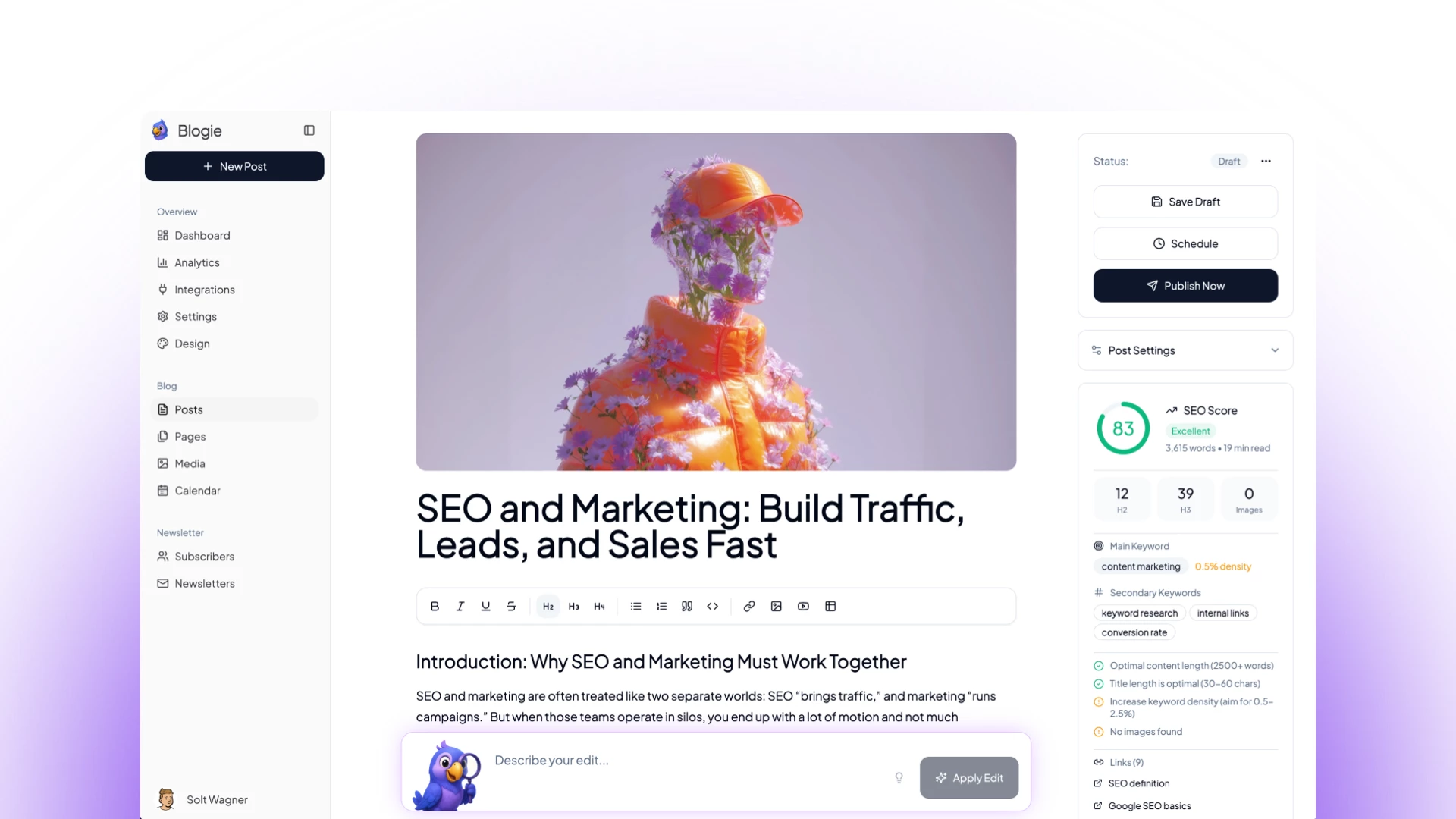
If you’re building a consistent publishing engine, a platform like Blogie fits nicely because it’s designed around the whole workflow—not just generating text.
So, What Is an AI Blogging Service—Really?

An AI blogging service is basically a system that helps you plan, write, edit, and publish blog content using AI—usually with some level of SEO guidance baked in. The confusing part is that the market uses the same phrase to describe two very different things: “tools” you operate yourself and “done-for-you” services where someone else runs the tool and delivers posts to you.
The simplest definition (tools vs. done-for-you services)
Tool-style platforms give you a workspace: you provide a topic, maybe a few notes, and the software generates AI blog writing drafts, headings, and sometimes keywords. Done-for-you services act more like an agency—your input becomes a brief, and their team uses AI plus editors to deliver final content. In my experience, tools work best when you want control and speed, while done-for-you works best when you want minimal involvement.
What’s typically included in the deliverables
Most AI blogging service offerings include an outline, a draft, basic on-page SEO (titles, meta description, headings), and sometimes an image suggestion or a featured image. Better ones add keyword research, competitor scanning, internal linking prompts, and an editor experience that makes it easy to refine the post. If you’ve ever collected “prompt libraries,” you’ll recognize the idea—AI Blog Prompts to Create Blogs is a good example of how prompts shape output, even when the tool feels “automatic.”
How pricing models usually work
Pricing usually falls into monthly subscriptions (with post limits), usage-based pricing (credits/tokens), or per-article fees for managed services. Watch for what’s included: some plans charge extra for SEO features, publishing, or multiple brands. If you’re trying to publish consistently, the best value often comes from a platform that combines writing + publishing + distribution—like Blogie.ai—so you’re not paying for three separate tools.
How AI Blog Writing Actually Works Behind the Curtain

If you’ve used AI-generated content tools and wondered why one draft is surprisingly good and the next one feels off, it helps to understand the basics. You don’t need a computer science degree—just a clear idea of how AI “predicts” language and why your instructions (and context) matter so much.
LLMs in plain English: prompts, context, and patterns
Most modern AI blog writing tools use large language models (LLMs), which are trained to predict the next word based on patterns in huge amounts of text. Your prompt tells the model what role to play and what outcome you want, and “context” includes any extra details you provide—audience, tone, structure, and examples. The more specific your context, the less generic the output tends to feel.
Where the training data comes from (and what that means)
Training data is typically a mixture of licensed sources, public web text, and other datasets, depending on the provider. The practical takeaway is that AI can mirror common phrasing and widely repeated “facts,” but it doesn’t inherently know what’s true right now. That’s why pairing AI drafting with human review is essential, even if you start with a tool like Free AI Blog Writer or a more end-to-end platform.
Why the same prompt can produce different drafts
AI responses include an element of randomness (often controlled by settings like temperature), which means the model can take different routes to answer the same request. Even without settings, small changes—like adding one competitor URL or one audience detail—can steer the draft dramatically. This is also why a solid AI blogging service focuses on repeatable workflows, not “magic prompts.”
Platforms such as Blogie aim to reduce that variability by guiding you through structured inputs—so the system can generate more consistent, publish-ready content instead of a random one-off draft.
The Real Benefits: Speed, Scale, and Consistency
Most people come to an AI blogging service for speed, but the deeper benefit is consistency. When publishing becomes easier, you get more shots on goal: more pages indexed, more internal links, more chances to match search intent, and more opportunities to convert readers into subscribers or customers.
Publishing cadence without burning out your team
Writing good content is mentally expensive, and “just write more” isn’t a serious plan for most teams. With blog content automation, you can create a draft in minutes and spend your energy polishing what matters: the examples, the POV, the calls-to-action, and the accuracy. I’ve found this is the difference between publishing occasionally and publishing predictably.
Turning one idea into multiple content formats
A strong post can become a newsletter, a LinkedIn carousel, a short video script, or a help-center article—if you have a process to repurpose it. Many AI content writing service platforms help generate these variations quickly, so your best ideas don’t die as “one blog post.” Even simple generators like AI Blog Writing Tool show how quickly AI can reshape a message for different formats.
Keeping voice and structure consistent across authors
When multiple people write, brand voice tends to drift—especially as you scale. A good AI blogging service can enforce consistent structure (headings, formatting, tone) while still leaving room for your team’s personality and expertise. If you’re building a blog on Blogie.ai, the built-in editor and workflow make it easier to standardize your “house style” without turning everything into bland template text.
Speed: faster drafts, faster updates, faster repurposing
Scale: more content clusters without more meetings
Consistency: repeatable structure and tone across posts
Where AI Blog Content Goes Wrong (and How to Catch It)

AI can write clean paragraphs all day long, but it can also produce confident nonsense. The risk isn’t just embarrassment—bad information can hurt trust, rankings, and sometimes even create legal problems. If you’re using an AI blogging service, your goal should be “fast drafts” plus a safety net that catches the common failure modes.
Hallucinations, outdated info, and fake citations
AI sometimes invents statistics, misquotes sources, or references studies that don’t exist. It’s not being sneaky—it’s predicting what a citation “should” look like based on patterns. The fix is straightforward: require real sources, click every link, and replace shaky claims with either verified data or clearly stated opinions.
Generic content that doesn’t rank or convert
Generic content usually happens when the input is generic—“write a blog post about email marketing” will produce something that sounds like everything else. To rank, you need specificity: a defined audience, a unique angle, real examples, and internal links that guide readers to your product. It’s worth reading guides like A complete guide to using a because they highlight the same pattern: AI needs direction, and your process needs standards.
When AI creates legal/brand risk
Brands in regulated spaces can’t treat AI-generated content like a casual draft—claims about pricing, outcomes, or compliance can create risk quickly. Even in non-regulated niches, AI can accidentally mimic phrasing too closely from existing articles, or make promises your product doesn’t support. A simple editorial checklist—accuracy, originality, and brand alignment—prevents most of this.
Verify facts (dates, numbers, features, pricing)
Remove or rewrite unsupported claims
Add firsthand examples and product-specific screenshots where possible
Run plagiarism checks if you publish at scale
If you’re publishing directly from a platform like Blogie, it helps that writing, editing, and final review can happen in one place—fewer copy/paste steps means fewer “oops” moments.
Will Google Punish AI Content? What Search Guidelines Actually Say

The fear is understandable: nobody wants to invest in content and then watch it disappear from search results. But Google’s stance is more nuanced than “AI is bad.” What matters is whether the content is helpful, original enough to be worth ranking, and created for people instead of manipulated for algorithms.
Spam vs. helpful content: the line that matters
Google’s problem is spam at scale—thin pages created purely to capture clicks without offering real value. If your AI SEO content reads like a stitched-together summary of top-ranking posts, that’s a red flag. If it answers the query clearly, includes accurate details, and supports user intent, AI involvement alone isn’t the issue.
E-E-A-T and why human review still matters
E-E-A-T (Experience, Expertise, Authoritativeness, Trustworthiness) isn’t a checkbox, but it’s a useful lens. AI can help organize and draft, but human review adds the lived experience, the careful sourcing, and the accountability that builds trust. How I'm Using AI to Write captures this reality well: AI is a writing partner, not a replacement for responsibility.
Practical ways to make AI content “helpful-first”
If you want AI-generated content to perform long-term, build “helpful” into your workflow. Use clear author bios, add original examples, include updated screenshots, and cite sources you’ve personally verified. Also, write for a specific reader—your ideal customer—not a vague “general audience” that no one actually belongs to.
Add a real POV: what you recommend and why
Use current numbers and link to primary sources
Include product-specific steps (not just theory)
Update posts quarterly to keep them accurate
One advantage of publishing on blogie.ai is that you can keep drafting, editing, and updating in the same environment—so “content maintenance” doesn’t become a separate, forgotten project.
The Workflow That Gets the Best Results (Human + AI)

The best results I’ve seen don’t come from asking AI to “write a post” and publishing it raw. They come from a workflow where AI does the fast parts and humans do the careful parts. If you’re using an AI blogging service like Blogie, you can turn that workflow into a repeatable pipeline your team can actually stick to.
Brief → outline → draft → edit → optimize → publish
A short brief is the difference between “meh” content and content that sounds like you. Start with audience, search intent, angle, and 3–5 key points you want included, then let AI generate the outline and draft. After that, edit for clarity and voice, optimize headings and internal links, then publish and schedule distribution.
Best checkpoints for fact-checking and sourcing
I like to fact-check twice: once after the outline (to confirm the approach is accurate) and again after the draft (to verify every claim that sounds like a “fact”). Require real links for stats, tools, and definitions, and if AI can’t provide a verifiable source, either find one yourself or remove the claim. This is the unsexy step that keeps AI blog writing safe and credible.
How to build a repeatable content pipeline
A pipeline is just a set of rules and deadlines that make publishing predictable. Decide your cadence (for example, 2 posts/week), create templates for briefs, and use a single platform to draft, edit, and publish so work doesn’t get lost across docs and tabs. Tools like ContentBot - AI Content Automation and show the broader automation angle, but an all-in-one workflow (draft → publish → email subscribers) is where teams usually feel the biggest relief.
Weekly: pick topics, assign briefs, generate outlines
Midweek: draft + edit + add links/images
End of week: publish + distribute + review analytics
Choosing the Right AI Blogging Service for Your Business
Not all AI blogging service options are built the same, and the “best” one depends on how work. Some teams want a writing assistant. Others want a full publishing system that handles scheduling, SEO, and distribution. Before you commit, it helps to ask questions that reveal whether you’re buying a shiny demo or a system you’ll still be using three months from now.
Questions to ask before you sign anything
Start with the practical stuff: How does it handle keyword research, internal linking, and content updates? Can you publish to a custom domain, or are you stuck exporting text into another CMS? If you want fewer tools, look for a platform approach—Blogie is positioned exactly for that “one place to manage blogging” workflow.
Red flags: outsourced fluff, no sources, no editor
If the service can’t explain how it avoids hallucinations, that’s a problem. If it can’t support sourcing or give you a clean editing workflow, you’ll end up spending more time cleaning drafts than you would writing from scratch. Also watch for “SEO” that just means keyword stuffing—real AI SEO content should be structured around intent and usefulness, not density formulas.
What “good” looks like: samples, process, revisions
A credible service shows samples in your niche and explains the process from brief to final draft, including how revisions work. You should be able to request changes to voice, structure, and level of detail without starting over each time. In my experience, the best sign is when the service talks about editing and publishing as much as it talks about generation.
What to check | Why it matters |
|---|---|
Editing workflow | You’ll spend 30–50% of time refining, so it must be easy |
SEO support | Intent + structure beats “keywords sprinkled everywhere” |
Publishing + scheduling | Consistency comes from reducing steps and tool-hopping |
Source handling | Prevents hallucinations and protects your credibility |
Costs, ROI, and What You’re Actually Paying For

Pricing for an AI blogging service can feel all over the place, mainly because you’re not just paying for words—you’re paying for workflow, speed, and (ideally) fewer bottlenecks. If you evaluate tools only on “cost per article,” you’ll miss the real cost drivers: editing time, publishing overhead, and whether the content actually performs.
Common pricing tiers and what they include
Entry tiers usually cover drafting and basic editing, while mid tiers add keyword suggestions, more generations, and collaboration features. Higher tiers may include multi-site management, analytics, and automation for publishing and email notifications. If you want the “single workspace” effect, a platform like Blogie.ai can reduce stacked subscriptions (writer tool + CMS + email tool + image tool).
How to estimate ROI from traffic, leads, and time saved
ROI is easiest when you pick one primary goal per content cluster: traffic, leads, or product activation. For traffic, estimate value using conversion rates: for example, 2,000 extra monthly visits × 1% email signup rate = 20 subscribers; then estimate how many subscribers become customers. Also count time saved—if AI reduces drafting time by 3 hours per post and you publish 8 posts/month, that’s 24 hours reclaimed.
Hidden costs: editing, images, compliance, SMEs
The most common “surprise cost” is editing, especially if drafts are generic or inaccurate. Images and screenshots take time too, and regulated industries may need subject-matter experts (SMEs) to approve claims. A good AI content writing service reduces these costs with better briefs, better drafts, and an editor that makes revisions painless.
Visible costs: subscription, seats/users, usage limits
Hidden costs: human editing hours, sourcing, reviews, updates
Use Cases That Work Best (and Ones That Usually Don’t)
The truth is, AI blogging service workflows shine in certain scenarios and struggle in others. The key is matching AI’s strengths—speed, structure, pattern recognition—to content types where those strengths translate into real business results. When you force AI into high-stakes writing without the right guardrails, things get risky fast.
Best fits: SEO clusters, product education, newsletters
SEO clusters are a natural fit because they require consistent structure across many related posts, which AI handles well. Product education also works great: tutorials, “how it works” explainers, and comparison pages become easier when AI helps draft and you add screenshots and real steps. Newsletters are another sweet spot—AI can reshape blog content into a tight weekly send, especially if your platform supports notifying subscribers (which is one reason I like the all-in-one approach of Blogie).
Risky fits: medical, legal, and finance without SMEs
Medical, legal, and finance content can’t rely on AI-generated content without expert review, because incorrect advice can harm people and create liability. Even small errors—dates, thresholds, claims about outcomes—can turn into big problems. If you operate in these spaces, treat AI as drafting support only, and build a mandatory SME approval step into your pipeline.
When to stick with fully human writing
If the post depends on original reporting, interviews, or a strong founder voice, fully human writing often wins. The same goes for thought leadership where your credibility is the product—your unique experience and language matter more than speed. In those cases, you can still use an AI blogging service for outlining and editing support, but the core content should come from a person.
Content type | AI fit | Best approach |
|---|---|---|
SEO how-to posts | High | AI draft + human examples + publish workflow |
Thought leadership | Medium | Human core + AI structure and editing |
Regulated advice | Low without SMEs | SME-led + AI support only |
A Simple Checklist to Start Using an AI Blogging Service Today
If you want to get value quickly, you don’t need a 40-page content strategy document. You need a clear goal, a repeatable workflow, and a way to measure whether you’re actually improving. This is where an AI blogging service can feel like a relief—especially if you choose a platform that covers drafting, publishing, and distribution in one place.
Define your goals: traffic, authority, or conversions
Pick one main outcome for the next 30 days so your decisions don’t get messy. If you want traffic, focus on search intent and clusters; if you want authority, publish deeper posts with original examples; if you want conversions, write product-led content that answers “should I use this?” and “how do I do it?” clearly. Goals shape everything from topic selection to CTAs and internal links.
Set brand voice rules and sourcing standards
Create a one-page voice guide: tone (friendly, direct), reading level, formatting rules, and “always/never” phrases. Then set sourcing standards: where stats can come from, how to cite tools, and what requires manual verification. This is how you keep AI blog writing from drifting into generic filler, even as you scale output.
Measure results and iterate every 30 days
Track a small set of metrics: published posts, impressions, clicks, average position, email signups, and trial starts (or your equivalent). Every 30 days, identify the top 20% posts by performance and replicate what worked—topic angle, structure, and internal linking. With Blogie.ai, it’s easier to stay consistent because the writing, scheduling, and publishing steps live together instead of being scattered across tools.
Week 1: choose 6–8 topics, write briefs, generate outlines
Week 2: draft and publish 2–4 posts
Week 3: publish 2–4 more, repurpose into email + social
Week 4: review analytics, update winners, refine prompts/briefs
If you want the simplest next step: pick one topic you already know your customers care about, generate a draft with an AI blogging service, add real examples from your product, and publish it. Then repeat weekly until consistency becomes your competitive advantage.
This article was created using Blogie.
This article was created using Blogie.